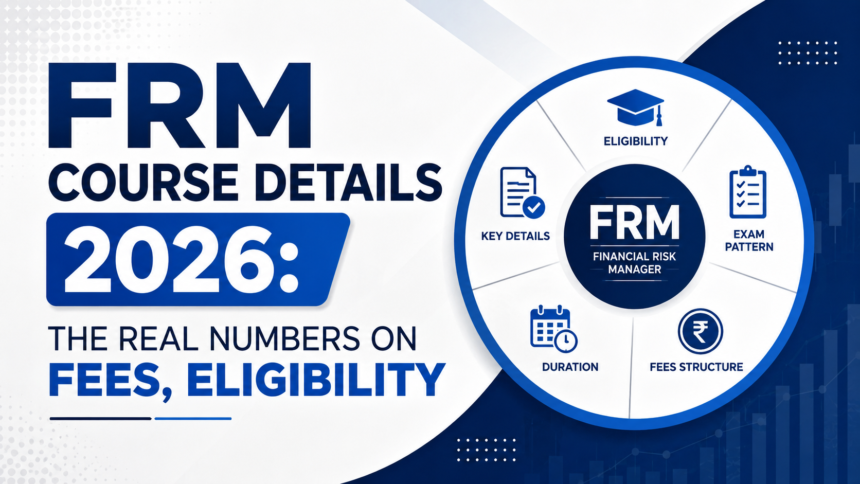
Planning to sit for the FRM exam this year? Before you register, it helps to know exactly what you’re paying for and when. GARP has set its 2026 calendar, and the fee structure has a few moving parts that trip people up if they don’t check early. Below are the FRM course details you actually need, pulled straight from GARP’s current schedule.
What the FRM Certification Actually Involves
GARP, or the Global Association of Risk Professionals, runs the FRM course in two stages: Part 1 and Part 2. You need to clear both before you can call yourself FRM certified. There’s no degree requirement to sign up for Part 1, so students and working professionals both walk through the same door.
Who Can Sit for the Exam
No academic background is required. A commerce student, an engineer, or someone five years into a banking job can all register for Part 1 without any prior qualification check. The only requirement that comes later is two years of relevant work experience, and that’s needed only after you clear Part 2, not before.
How the Exam Is Structured
Part 1 runs for four hours and has 100 multiple-choice questions. These FRM course details on syllabus weightage break down like this:
- Foundations of Risk Management: 20 percent
- Quantitative Analysis: 20 percent
- Financial Markets and Products: 30 percent
- Valuation and Risk Models: 30 percent
Part 2 goes deeper into applying these concepts across credit risk, market risk, and operational risk scenarios.
FRM Course Fees for 2026
This is where most people get confused, so let’s break it down properly. Whether you study through an FRM online program or attend classroom sessions, GARP’s exam fees stay identical since coaching cost and exam cost are separate things.
There’s a one time enrolment charge, plus a per part exam fee that changes based on when you register.
| Fee Component | Amount (USD) | Approx in INR |
| Enrolment fee (one time) | 400 | 33,000 to 35,000 |
| Early registration | 600 per part | Around 50,000 |
| Standard registration | 800 per part | Around 67,000 |
| Late registration | 1,000 per part | Around 83,000 |
What a First-Timer Pays
Register early for Part 1 and your total comes to USD 1,000, that’s the 400 enrolment fee plus 600 exam fee. Wait past the early deadline and it jumps to USD 1,200. The good part is the enrolment fee is charged only once, so when you come back for Part 2, you’re only paying the exam fee again, somewhere between 600 and 800 dollars.
Add both parts together with basic prep material, and most candidates land somewhere between USD 2,150 and USD 3,600 by the time they’re done. Go for premium coaching or travel to a test centre outside your city, and that number climbs further.
Charges People Forget to Budget For
- Paying by wire transfer or ACH adds a flat USD 50 on top
- Want to push your exam to the next window? A deferral costs USD 250
- GARP’s own curriculum books run about USD 250 to 300 per part if you buy them separately
- You’ll also need an approved calculator, either the Texas Instruments BA II Plus or the HP 12C, priced between USD 50 and 150
How Long Does the FRM Course Take
GARP doesn’t set a fixed classroom duration since this isn’t a semester based course, it’s exam driven. That said, most people preparing through FRM online platforms or on their own spend six to nine months getting ready for each part.
Realistic Study Hours
Data from past candidates shows an average of around 240 study hours for Part 1 alone. Spread that across a working schedule and you’re looking at three to four months of steady preparation, assuming you study most days of the week.
Time to Finish Both Parts
If you attempt Part 1 and Part 2 back to back in consecutive windows, expect the full process to take somewhere between twelve and eighteen months from your first registration to clearing Part 2. This shifts depending on your weekly study hours and whether you pass on the first try or need a retake.
FRM Exam Windows in 2026
GARP holds the exam three times a year, in May, August, and November. Within each window, you pick your own test date when booking through a PSI centre.
Dates to Note This Year
- May 2026 window is already over
- August 2026 falls on the 7th and 8th for Part 1
- November 2026 runs from the 14th through the 20th
Deadlines That Matter
Early registration for the November window is currently open. Lock in your seat before that deadline and you pay 600 dollars per part instead of 800. Miss it, and the price climbs again as the exam date gets closer.
When Results Come Out
GARP usually puts results up on your candidate portal about eight weeks after the exam window shuts. So if you’re sitting in August, expect your score around early October.
FRM Online Courses vs Classroom Coaching
A lot of candidates now lean toward FRM online formats simply because they fit around a job or college timetable better than fixed classroom slots. Recorded lectures, practice banks, and doubt sessions on your own time are standard with most online programs.
Classroom coaching still works well if you need a fixed routine and don’t trust yourself to stick to a self study plan. Both paths cover the same GARP syllabus, so your choice really comes down to how you learn best, not which one gives better results.
Things Worth Checking Before You Enrol
- Is the study material actually updated for the 2026 syllabus, or is it recycled from last year
- Do the mock tests match the real exam’s difficulty level
- Can you get your doubts cleared quickly, or only during scheduled sessions
- How does the coaching fee compare across providers, since this is separate from what GARP charges
Conclusion
Sorting out your FRM course details before you jump in, the fees, the exam windows, how long prep actually takes, makes the whole journey a lot smoother. GARP’s 2026 calendar gives you clear windows in August and November, and registering early saves real money on both parts. Pick FRM online learning or classroom coaching based on what fits your schedule, not what sounds better on paper, and you’ll walk into your exam window prepared instead of scrambling at the last minute.