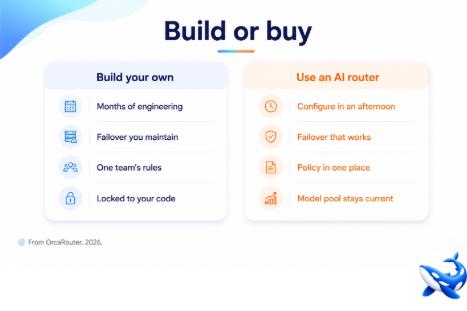
The temptation to build your own routing layer is real: it seems simple — call this model, fall back to that one — and it keeps everything in house. The reality is that “simple routing” turns into failover logic, provider-health monitoring, rate-limit handling, cost accounting, and a model pool that has to stay current as vendors ship. An AI router is the built-and-maintained version of that layer. OrcaRouter is one platform built around this pattern.
What building your own actually involves
Failover. Handling a provider outage gracefully means detecting it, choosing a healthy alternative, and retrying without a storm of parallel requests. Most home-built versions get the happy path right and the failure path wrong.
Provider health. Knowing which provider is slow or down right now is a monitoring problem, not a one-time decision. Without it, your failover is guessing.
Cost accounting. “How much did this feature cost” needs per-model, per-team tracking. Building that is an observability project.
The moving pool. Vendors ship models, change prices, deprecate endpoints. Your router has to track that, or you are routing to yesterday’s reality.
None of these is hard in isolation. Together they are a platform, and the maintenance is forever.
The honest comparison
Time. A competent team can build a working single-model fallback in weeks; a reliable, observable, cost-accounted router across vendors is a multi-quarter project.
Maintenance. The build is the easy part; the ongoing tracking of model availability, prices and new releases is the long tail.
Focus. Every hour spent on your router is an hour not spent on your product. For most teams, the routing layer is infrastructure, not differentiation.
When building makes sense
If you have one model, one provider, and no failover requirement, you do not need a router at all — build or buy is moot. If you have an unusual constraint a router cannot meet, or the volume is so specific that the pool is one model, in-house is defensible. Beyond that, the economics strongly favour the maintained layer.
The hidden cost: your team’s attention
There is a cost to building your own that never appears on a spreadsheet: attention. Every hour spent maintaining a router is an hour not spent on the product, and the maintenance is not a one-time build — it is a standing responsibility that grows as the model landscape does. When a vendor ships a new model, changes pricing or deprecates an endpoint, someone has to track it and update the routing logic. That is a permanent tax on a team whose differentiation is almost certainly not “we maintain our own model-routing infrastructure.” The build-vs-buy question is really about whether routing is your product or your plumbing, and for almost every team it is plumbing.
The decision rule
A clean decision rule: if routing is your product’s differentiator, build it. If routing is plumbing between your product and the models, buy it. Very few teams fall in the first category, and the teams that think they do usually discover that their differentiator is the application on top, not the routing layer underneath. The router is where most teams should spend the least engineering attention — which is exactly the argument for adopting one that is already built and maintained.
The maintenance math
The honest maintenance math is not the build time; it is the ongoing obligation. Every vendor pricing change, every new model release, every endpoint deprecation is someone’s job to track and reflect in the router. That is a recurring cost a home-built router never stops charging, and it grows as the model catalogue grows. A maintained router spreads that tracking across the platform’s users; a home-built one concentrates it on your team. Over a year, that difference in attention is usually the deciding factor — not whether the routing logic was hard to write, but whether anyone wants to keep writing it forever.
The math most teams skip
The build-versus-buy decision usually gets made on the cost of building the happy path: “it’s just calling a model with a fallback.” The math most teams skip is the total cost of ownership over the life of the system. The happy path is maybe two weeks of work. The unhappy path — provider outages, rate limits, a model that drifts in quality, a vendor that changes pricing, a new model that should be added to the pool — is where the time actually goes, and it never stops. A home-built router means your team owns all of that forever, including the tracking of a model catalogue that changes faster than any individual team can comfortably follow.
There is also the opportunity cost, which is the largest line and the least counted. Every engineer-hour spent on routing infrastructure is an engineer-hour not spent on the product your users pay for. The routing layer is rarely where a product differentiates; the application on top of it is. A maintained router spreads the maintenance across many users and keeps the tracking current; a home-built one concentrates it on your team, forever, at exactly the time your team should be focused on the product.
The case for building your own is narrow and honest: you have a routing requirement that no product meets, or your differentiation genuinely is the routing itself, or your compliance needs dictate full control. Outside those, the economics are lopsided. Building a router is not hard. Maintaining it, keeping it current, and keeping your attention on the product instead — that is the cost the build-versus-buy decision too often ignores.
The takeaway
Building your own router looks cheap and is not: failover, provider health, cost accounting and a moving model pool are a platform, and the maintenance never ends. An AI router is that layer built and maintained, configured in an afternoon instead of built over quarters. If your product is differentiated by the routing itself, build it. If your product is everything on top of the models, do not spend your engineering time reinventing the plumbing.
Sourcing note: this article describes the AI-router category and OrcaRouter’s implementation. Build-versus-buy reasoning is analysis; OrcaRouter’s routing, failover and observability claims are its own published descriptions, checked August 2026.