
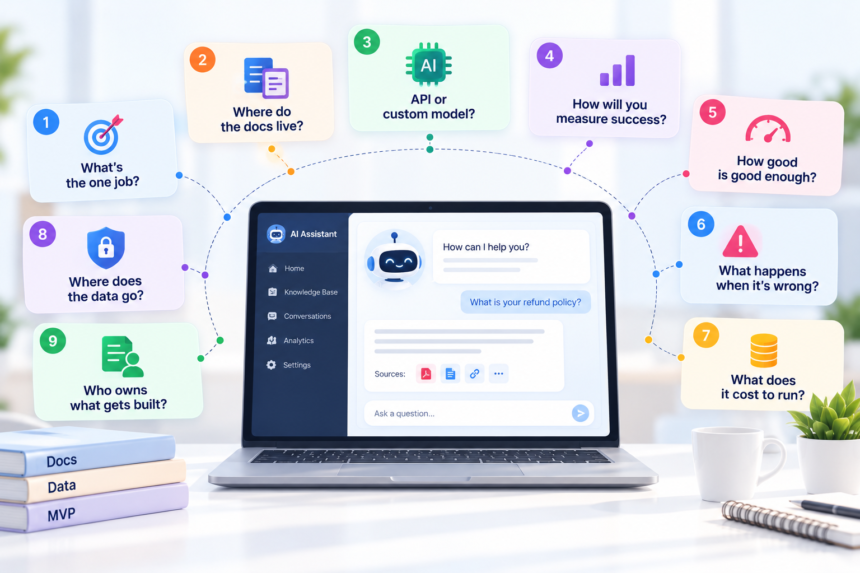
Say a software company wants a chatbot that answers customer questions from its docs. Weekend job, right? For a demo, yes. But for something customers can use without anyone wincing, no, and the gap between those two is most of what follows. Nine questions decide how big the MVP gets.
A caveat before any numbers: they come from agency blog posts, and agencies sell this stuff. So with that said, AI ML development pricing starts around $10,000 to $35,000 for a simple API-based MVP, and $15,000 to $60,000 for a leaner build that takes 6 to 14 weeks. Regulated or retrieval-heavy work starts around $120,000. Wide, yes. But then everything in AI pricing is.
And sometimes the cheapest honest answer is that a better search box would do the job.
1. What’s the One Job?
We’d pick one job and defend it. “Answer questions from the docs” is a job. “An AI assistant for the business” is a wish. Teams with one job ship. And teams with five argue about the fifth. A decent partner offering AI application development services says no to job number two in version one, and you’ll thank them in month three.
2. Where Do the Docs Actually Live?
Somewhere ugly, usually. A help center, a couple of PDFs, a few Google Docs that two people edit and one person trusts. Some contradict each other. Cleaning that up is project one, and it’s where the money goes, because most of an AI MVP’s budget, the agencies say, lands in data pipelines, evaluation, prompts and infrastructure while the model itself is a small slice. Yet people expect the opposite.
3. API or Custom Model?
Use a hosted model. Training your own needs proprietary data and a payoff you can name, and an MVP rarely has either. But if the bills or the quality push back later, revisit it then.
4. How Will Anyone Know It Works?
Collect fifty real customer questions. Write down what a good answer looks like. Rerun them after every change. Skip this, and nobody knows whether Tuesday’s tweak helped or broke Monday’s fix. One source puts evaluation, observability and guardrails at 15 to 30 percent of the AI portion of the budget, so on a $40,000 build with $30,000 of AI work, that’s $4,500 to $9,000. And prototypes skip it, which is half of why they look cheap.
5. How Good Is Good Enough?
Drafting internal emails? Wrong sometimes is fine. Answering refund questions? Not fine. Pick the bar first, otherwise the polishing never ends (it might anyway, but now there’s a line to point at).
6. What Happens When It’s Wrong?
Because it will be. The user gets handed to a person, told “I’m not sure”, or served a confident mistake. The third is how Air Canada landed in front of a tribunal. In 2024 it was ordered to pay a customer because its chatbot got a fare rule wrong. Klarna’s version was milder. It boasted that its AI assistant did the work of 700 agents, then hired humans again when quality dropped. So yes, a handoff path adds scope. Pay for it anyway.
7. What Does It Cost to Run?
Launch cost gets the attention. The monthly bill gets the surprises. For a small user base it can sit at a few hundred dollars, maybe a couple of thousand. With real traffic, five figures isn’t unusual (agency estimates, so loose). Agents push it higher, since each step calls the model again. So track cost per question from week one.
8. Where Does the Data Go?
Customer questions going to a hosted model raise contract questions. Where’s it stored? Is it used for training? Who reads the logs? Ask before launch. After launch, the answers get pricey.
9. Who Owns What Gets Built?
Contracts should hand over the code and the prompts, plus the evaluation set. Some vendors hold on to pieces without really meaning to. You find out the day you switch.
Why the Demo Lied
The weekend prototype is missing the dull stuff: retries, input checks, logging. Then the first real user breaks it, and nobody can say why. A vendor who only shows a demo is showing the cheap part, and strong AI application development services admit that up front.
Scoping With AI ML Development in Mind
Good AI ML development for an MVP picks the minimum that teaches something: one job, a small real dataset, an evaluation set and a human fallback. We’d fix those first and estimate after, because budgets built the other way round get rewritten in month two, usually right when the first invoice has been paid and everyone is a little less flexible. BiztechCS, which delivers AI/ML Development and GenAI Solutions for mid-market businesses, tends to start the same way.