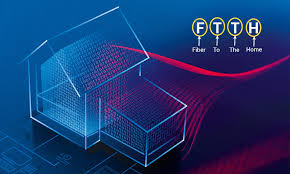
As digital life accelerates, the demand for faster, more reliable internet has become universal. From video conferencing and online gaming to smart home systems and remote work, today’s digital services require far more than traditional broadband networks can handle. Enter FTTH—Fiber to the Home, a technology rapidly emerging as the global standard for next-generation broadband.
Unlike copper-based networks, FTTH delivers fiber optic connectivity directly to individual homes, enabling unprecedented speeds, stability, and scalability. But why is FTTH considered future-proof? And how are service providers making this transition?
In this article, we break down what makes FTTH superior, how it compares to legacy broadband options, and how ISPs can capitalize on this shift.
What Is FTTH?
FTTH is a fiber access architecture where optical fiber runs all the way from the central office to the end-user premises—be it a home, apartment, or office. Unlike other FTTx architectures like FTTN or FTTC that still rely on copper in the last mile, FTTH eliminates these legacy bottlenecks by delivering pure fiber to the end-user.
FTTH provides:
- Blazing-fast symmetrical speeds, often up to 10 Gbps or more
- Minimal latency, crucial for real-time and cloud-based services
- High reliability, immune to electromagnetic interference
- Lower signal degradation, regardless of distance from the central office
These capabilities make FTTH not just a faster solution, but one that can scale to meet bandwidth demands for decades.
FTTH vs. Traditional Broadband Technologies
| Feature | FTTH | Cable (DOCSIS 3.x) | DSL |
| Medium | Optical fiber | Coaxial cable | Twisted-pair copper |
| Download Speed | Up to 10 Gbps+ | Typically <1 Gbps | Up to 100 Mbps |
| Upload Speed | Symmetrical (1–10 Gbps) | Asymmetrical | Low (1–10 Mbps) |
| Latency | <5 ms | 10–25 ms | >25 ms |
| Signal Attenuation | Minimal | Moderate | High |
| Future Scalability | Excellent | Limited | Very limited |
Cable and DSL are still widely used, but both are reaching the limits of their capabilities. Cable networks, for instance, struggle to support consistent upload performance—a crucial shortcoming in the age of remote collaboration, cloud storage, and video streaming.
Why FTTH Is the Future of Internet Infrastructure
- Unmatched Performance
FTTH supports multi-gigabit speeds for both download and upload. This performance is critical for:
- High-resolution video conferencing (4K, 8K)
- Real-time cloud applications (Google Workspace, Microsoft 365)
- AR/VR streaming and metaverse experiences
- Multi-user households with smart home ecosystems
Traditional broadband solutions simply cannot compete.
- Long-Term Scalability
Unlike copper, fiber optics are not a limiting factor in future upgrades. A single installed fiber can support multiple generations of passive optical network (PON) standards—from GPON to XGS-PON to 25G/50G PON—by simply upgrading the terminal equipment. For fiber operators, effective network asset management ensures these long-life assets deliver maximum value, making FTTH a highly capex-efficient solution for ISPs planning 10–15 years ahead.
- Energy Efficiency and Sustainability
Fiber networks are inherently more energy-efficient than copper or coaxial networks. They produce less heat, require fewer signal amplifiers, and have a longer lifespan, often 25+ years. This makes FTTH the environmentally responsible choice—especially as network sustainability becomes a regulatory and corporate priority.
- Symmetrical Connectivity for a Cloud-Driven World
With work-from-home, distance learning, and cloud-first business tools becoming permanent fixtures of life, upload speeds now matter as much as download speeds. FTTH enables true symmetry, eliminating the bottlenecks users face with cable broadband.
Global Momentum: FTTH Adoption Is Accelerating
Governments and telecom providers worldwide are embracing FTTH:
- China leads the world in FTTH coverage, with over 90% of broadband users on fiber.
- In Europe, countries like Spain, France, and the Netherlands are deploying FTTH aggressively, with over 200 million homes expected to be passed by 2026.
- United States providers, including AT&T, Google Fiber, and Frontier, are investing billions in fiber rollouts, especially in underserved suburban and rural areas.
- Middle East nations like the UAE and Saudi Arabia have integrated FTTH into their national broadband strategies.
This global push signals a clear trend: fiber is not optional—it’s inevitable.
What Does FTTH Mean for ISPs and Network Builders
For ISPs, FTTH opens the door to:
- Reduced maintenance costs (no need for active components like amplifiers)
- Longer infrastructure life cycle compared to copper or coaxial systems
- New revenue opportunities through triple-play services (internet, IPTV, VoIP), cloud applications, and smart city enablement
- Increased ARPU (Average Revenue Per User) due to better quality of service and added-value packages
But deploying FTTH successfully requires robust network architecture and reliable hardware.
FTTH Deployment Essentials: OLTs, ONUs, and More
At the core of any FTTH network are:
- OLT (Optical Line Terminal): Installed at the provider’s central office, the OLT controls and distributes optical signals to multiple endpoints.
- ONU/ONT (Optical Network Unit/Terminal): Located at the user’s premises, this device receives and converts optical signals into usable internet and voice/data output.
For ISPs targeting urban or high-density areas, solutions like the VSOL V5600X Series Chassis Combo PON OLT offer:
- High-density GPON/XG(S)-PON support
- Flexible slot design
- 1U to 6U options for modular expansion
- Multi-service aggregation (CATV, VoIP, Internet)
For end-users, dual-band ONU/HGUs support 2.4GHz/5GHz Wi-Fi, IPTV, and VoIP in a compact form—ideal for residential and SOHO deployments.
Choosing carrier-grade, scalable OLT and ONU devices ensures not just speed, but long-term reliability and upgrade flexibility.
Conclusion
With digital demands growing and legacy networks falling behind, FTTH has become the standard for broadband excellence. It offers unparalleled speed, future scalability, and the stability that users and businesses alike now expect.
For ISPs, transitioning to FTTH is both a technical necessity and a business opportunity. And for consumers, it’s the key to unlocking seamless digital living—from 4K streaming to smart homes and beyond.