Every mechanic knows the frustration of staring into a dark cylinder bore or trying to assess wear inside a transmission housing without being able to actually see what’s happening. You angle a mirror, adjust your flashlight, and still end up guessing whether that shadow is a crack, carbon buildup, or just a trick of the light. These diagnostic blind spots lead to unnecessary teardowns, missed defects, and hours of wasted labor that cut into shop profitability and customer trust.
The inspection landscape has shifted dramatically in recent years. What was once the exclusive domain of dental mirrors and penlight combinations has given way to sophisticated visual tools capable of delivering crystal-clear images from inside the tightest mechanical cavities. Among these advances, rifle borescopes—originally designed for firearm barrel inspection—have emerged as surprisingly effective professional inspection cameras for automotive applications. Their precision optics, compact probe designs, and rugged construction make them uniquely suited to the demands mechanics face daily.
This article provides a thorough comparison between rifle borescopes and traditional automotive inspection tools, examining how each addresses the modern mechanic’s need for high-quality imaging, durable construction, and the flexibility required to navigate confined engine compartments and internal assemblies.
The Evolution of Automotive Inspection Tools: From Basics to Advanced Cameras
For decades, mechanics relied on a handful of simple tools to peer inside engines and mechanical assemblies. The angled dental mirror paired with a penlight was the standard approach through much of the twentieth century, offering a crude but functional way to check valve seats, cylinder walls, and bearing surfaces. Telescoping inspection mirrors added modest reach, while rigid fiber-optic scopes provided the first glimpse of true internal visualization—though their fixed angles and dim illumination left much to be desired.
The digital revolution changed everything. As miniaturized camera sensors became affordable and LED technology advanced, professional inspection cameras entered the automotive market with capabilities that would have seemed impossible a generation earlier. These tools could capture high-resolution images and video from inside running engines, sealed transmissions, and exhaust systems without requiring disassembly. Shops that adopted them early discovered dramatic reductions in diagnostic time and far fewer instances of “exploratory surgery” on customer vehicles.
Within this broader shift, rifle borescopes have carved out a distinctive niche. Originally engineered to inspect the tight, rifled bores of firearm barrels with exceptional clarity, these instruments translate remarkably well to automotive applications. Their rigid-yet-compact probe designs, superior optical systems, and purpose-built illumination make them increasingly popular as specialized automotive inspection tools in professional shops worldwide.
What is a Rifle Borescope? Defining the Modern Inspection Solution
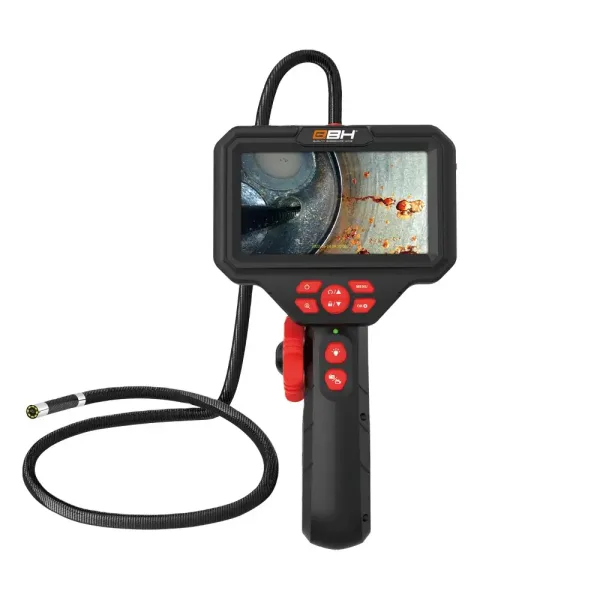
A rifle borescope is a precision optical instrument originally developed to examine the interior surfaces of firearm barrels, where even microscopic pitting, erosion, or fouling can affect performance. The tool consists of a narrow rigid or semi-rigid probe equipped with a miniaturized camera sensor and integrated LED lighting, designed to navigate extremely tight cylindrical passages while delivering sharp, well-lit images to an external display. What makes these devices particularly relevant to mechanics is their engineering philosophy: they’re built to produce exceptional image clarity within confined, dark spaces where traditional inspection methods simply cannot reach effectively.
Key Features of Rifle Borescopes
Modern rifle borescopes incorporate high-resolution camera sensors—often capturing images at 1080p or higher—that reveal surface details invisible to the naked eye or basic inspection mirrors. Their probes are engineered with precise diameters, typically ranging from 4mm to 8mm, allowing insertion into spark plug holes, injector ports, and narrow fluid passages without disassembly. Integrated LED arrays provide consistent, shadow-free illumination that eliminates the guesswork associated with external light sources. Many current models, including those from manufacturers like Teslong, feature dual lens borescopes with both forward-facing and side-viewing cameras, enabling mechanics to inspect cylinder walls and valve faces during a single insertion without repositioning. The construction prioritizes durability through aircraft-grade aluminum housings and scratch-resistant sapphire lens covers, ensuring these tools withstand the oil, solvents, and physical demands of daily shop use while maintaining optical performance over years of service.
Traditional Inspection Tools: An Overview of Common Methods
The traditional mechanic’s toolkit for internal inspection has remained remarkably consistent over the decades. Inspection mirrors—both fixed and telescoping—remain ubiquitous in toolboxes, offering a zero-cost way to redirect line of sight around corners and into recessed areas. Mechanical borescopes with rigid optical relay lenses provided the first dedicated internal viewing capability, though their fixed focal lengths and limited illumination restricted practical use to larger openings. Flexible fiber-optic scopes improved access somewhat, threading through curved passages where rigid instruments couldn’t follow. Magnetic pickup tools with attached LED lights serve double duty, combining retrieval with basic visual confirmation. These tools share genuine strengths: they require no batteries or charging, involve virtually no learning curve, they’re inexpensive to replace, and they function reliably in harsh environments without concern for electronic failure.
Limitations in Modern Automotive Diagnostics
Despite their simplicity, traditional tools increasingly fall short against the complexity of modern engines and drivetrains. Inspection mirrors provide only reflected, reversed images with no magnification, making it nearly impossible to distinguish hairline cracks from surface scratches on cylinder walls or valve seats. Fiber-optic scopes transmit dim, low-resolution images that degrade further with each bend in the bundle, and their inability to record findings means diagnostics depend entirely on the technician’s memory and interpretation. Tight access points common in turbocharged, direct-injection engines—such as narrow injector bores and integrated exhaust manifold passages—simply cannot accommodate traditional rigid scopes. Perhaps most critically, these tools offer no documentation capability, leaving shops unable to show customers visual evidence of internal wear or justify recommended repairs with objective imagery.
Comparative Analysis: Rifle Borescope vs. Traditional Tools for Mechanics
When evaluating these two approaches side by side, the differences become stark across every metric that matters in a professional shop environment. Image quality represents the most obvious gap—a rifle borescope delivers magnified, high-definition footage with consistent illumination, while an inspection mirror provides only what your eyes can resolve from a reflected, often poorly lit angle. The practical difference means catching a 0.2mm crack in an aluminum cylinder wall versus missing it entirely and sending a vehicle back to a customer with an undiagnosed issue. Flexibility and reach tell a similar story. Traditional mirrors and rigid fiber-optic scopes require a relatively straight path and adequate clearance, whereas modern borescope probes navigate through spark plug threads, injector bores, and even oil drain passages with minimal preparation. Ease of use initially favors traditional tools—there’s nothing to charge, connect, or configure with a mirror—but that advantage evaporates once you factor in the time spent repositioning, squinting, and second-guessing what you’re seeing. A borescope presents an immediate, unambiguous image on screen that any technician can interpret confidently.
Efficiency and Accuracy in Diagnosing Mechanical Issues
Consider a common scenario: a customer reports oil consumption on a turbocharged four-cylinder engine. With traditional tools, the diagnostic path often involves a compression test, a leak-down test, and if results are inconclusive, partial disassembly to visually inspect piston rings and cylinder walls. This process consumes two to three hours of billable labor before you’ve even confirmed the root cause. A rifle borescope changes that workflow entirely. Remove a spark plug, insert the probe, and within minutes you’re viewing the cylinder wall crosshatch pattern, piston ring lands, and valve stem seals in high resolution. Scoring, glazing, or carbon deposits become immediately visible, and the dual lens borescope capability allows switching between a side view of the cylinder wall and a downward view of the piston crown without withdrawing the instrument.
Transmission diagnostics benefit equally from this technology. Inspecting clutch pack wear, planetary gear tooth surfaces, or valve body bore condition traditionally required draining fluid and removing the pan at minimum—often leading to a full teardown if initial findings were inconclusive. A borescope inserted through the dipstick tube or a sensor port can reveal metal debris patterns, clutch material degradation, and gear surface pitting that pinpoint failure modes without disassembly. This accuracy translates directly to more precise repair estimates, fewer comeback situations, and the ability to document findings with recorded video that builds customer confidence in recommended services. Shops regularly report that diagnostic time drops by forty to sixty percent on internal engine and transmission assessments once borescope inspection becomes part of their standard workflow.
Why Rifle Borescopes Are the Future of Automotive Inspection
The comparison between rifle borescopes and traditional inspection tools reveals a clear trajectory in automotive diagnostics. While mirrors, fiber-optic scopes, and penlight combinations served mechanics adequately for decades, they cannot match the demands placed on modern shops working with increasingly complex engines and drivetrains. Rifle borescopes deliver high-definition imaging, consistent illumination, and documentation capabilities that transform internal inspections from educated guesses into confident, evidence-based diagnoses.
The practical advantages extend beyond image quality alone. Reduced diagnostic time, fewer unnecessary teardowns, and the ability to present visual proof to customers all contribute to improved shop efficiency and stronger client relationships. Durability features like waterproof probes and abrasion-resistant sheaths ensure these tools withstand the demanding conditions of daily professional use without sacrificing optical performance.
For mechanics still relying exclusively on traditional methods, the transition to borescope-based inspection represents one of the most impactful upgrades available. Starting with your shop’s most common diagnostic challenges and building proficiency through deliberate practice will yield measurable improvements in accuracy, workflow speed, and overall service quality that justify the investment many times over.