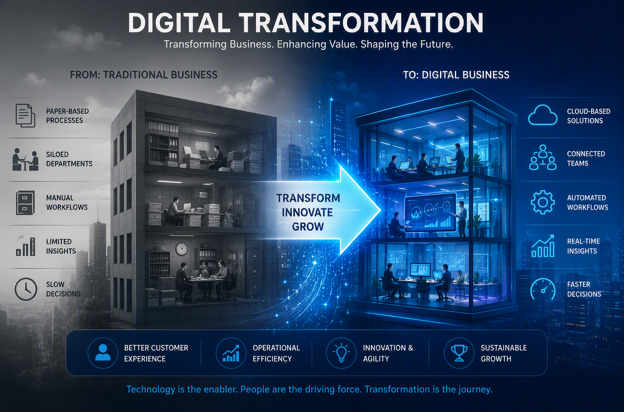
Organizations today operate in an environment defined by rapid technological change, evolving customer expectations and increasing competitive pressure. To remain competitive, businesses must continuously evaluate their performance, identify improvement opportunities and adopt technologies that drive measurable value. This is where benchmarking in business and digital transformation strategy consulting play complementary roles.
While benchmarking helps organizations understand how their performance compares with industry peers and leading practices, digital transformation strategy consulting provides the roadmap for closing performance gaps through technology, process optimization and organizational change. Together, they enable businesses to make informed decisions, improve operational efficiency and accelerate long-term growth.
What Is Benchmarking in Business?
Benchmarking in business is the process of comparing an organization’s performance, processes, capabilities and outcomes against industry peers, top-performing organizations or established best practices. The objective is to identify strengths, uncover performance gaps and prioritize initiatives that improve business performance.
Modern business benchmarking extends beyond comparing financial metrics. Organizations also evaluate operational efficiency, customer experience, workforce productivity, digital maturity, sustainability and innovation capabilities.
Rather than relying on assumptions, benchmarking provides objective data that helps leaders make strategic decisions based on measurable performance.
Why Benchmarking in Business Matters
Business leaders face constant pressure to improve profitability while managing costs, risks and changing market conditions. Without objective performance comparisons, it becomes difficult to determine whether internal improvements are sufficient or whether competitors are advancing more rapidly.
Benchmarking in business provides valuable insights that help organizations:
- Understand competitive positioning.
- Identify operational inefficiencies.
- Improve productivity and resource utilization.
- Support investment decisions.
- Measure digital maturity.
- Establish realistic performance targets.
- Accelerate continuous improvement.
Organizations that benchmark regularly are better equipped to adapt to changing business conditions and make evidence-based decisions.
What Is Digital Transformation Strategy Consulting?
Digital transformation strategy consulting helps organizations develop and execute strategies that modernize business operations through digital technologies, process redesign and organizational change.
Rather than focusing solely on technology implementation, consultants align digital initiatives with business objectives, ensuring investments generate measurable operational and financial outcomes.
A comprehensive digital transformation strategy typically includes:
- Digital maturity assessment.
- Business process optimization.
- Technology roadmap development.
- AI and automation opportunities.
- Data and analytics strategy.
- Cloud transformation planning.
- Governance and change management.
- Performance measurement.
The goal is to help organizations build scalable, technology-enabled operating models that support sustainable growth.
How Benchmarking Supports Digital Transformation
Organizations often begin digital transformation without fully understanding their current performance. This increases the risk of investing in technologies that fail to address the most significant business challenges.
By incorporating benchmarking in business, organizations establish a clear performance baseline before transformation begins. Benchmarking helps identify where operational gaps exist, which processes require modernization and which investments are likely to generate the greatest return.
For example, benchmarking can reveal opportunities to:
- Reduce operating costs.
- Improve customer service performance.
- Increase workforce productivity.
- Enhance procurement efficiency.
- Strengthen financial performance.
- Accelerate supply chain responsiveness.
These insights enable digital transformation strategy consulting teams to prioritize initiatives that deliver measurable business value.
Key Benefits of Benchmarking in Business
Organizations that adopt structured benchmarking practices experience several advantages.
Objective Performance Measurement
Benchmarking replaces assumptions with reliable performance data, allowing leaders to evaluate business performance objectively.
Better Strategic Planning
Performance comparisons help organizations prioritize investments based on measurable improvement opportunities.
Increased Operational Efficiency
Benchmarking identifies inefficient processes, enabling organizations to streamline operations and improve productivity.
Stronger Competitive Advantage
Understanding how leading organizations operate helps businesses adopt proven practices that improve performance.
Improved Decision-Making
Executives gain greater confidence when strategic decisions are supported by external performance data rather than internal estimates.
Benefits of Digital Transformation Strategy Consulting
A structured transformation strategy helps organizations maximize the value of digital investments while reducing implementation risks.
Business-Aligned Technology Investments
Consultants ensure technology initiatives directly support organizational priorities rather than isolated technology upgrades.
Process Optimization
Digital transformation simplifies workflows, eliminates manual activities and improves operational consistency.
Data-Driven Decision-Making
Modern analytics platforms provide leaders with real-time insights that support faster and more informed business decisions.
AI and Automation Adoption
Organizations can identify practical opportunities to implement artificial intelligence, intelligent automation and advanced analytics across business functions.
Organizational Agility
Technology-enabled operating models improve responsiveness to market changes, customer expectations and evolving business requirements.
Best Practices for Successful Digital Transformation
Organizations achieve better outcomes when transformation initiatives follow a structured approach.
Establish a performance baseline. Use benchmarking in business to understand current performance before defining transformation priorities.
Define measurable objectives. Set clear goals related to cost optimization, customer experience, productivity, revenue growth or operational efficiency.
Prioritize high-impact initiatives. Focus first on projects that deliver measurable business value within a reasonable timeframe.
Develop a scalable roadmap. Build transformation plans that support long-term growth while allowing incremental implementation.
Strengthen data quality. Reliable data improves analytics, automation and AI capabilities across the organization.
Invest in change management. Successful transformation depends on employee engagement, leadership support and continuous learning.
Common Challenges
Organizations frequently encounter several obstacles during digital transformation.
Legacy technology environments may limit integration opportunities and increase implementation complexity.
Fragmented business processes often reduce operational visibility and make standardization difficult.
Poor-quality data can limit analytics capabilities and reduce the effectiveness of AI initiatives.
Resistance to organizational change may slow technology adoption and delay business benefits.
Working with experienced digital transformation strategy consulting professionals helps organizations address these challenges through structured planning, governance and implementation support.
The Future of Business Performance
As artificial intelligence, automation and advanced analytics become increasingly integrated into enterprise operations, organizations will need more sophisticated approaches to performance improvement.
Future business leaders will rely on continuous benchmarking, predictive analytics and AI-driven insights to evaluate performance and identify improvement opportunities in real time.
At the same time, digital transformation strategy consulting will continue evolving beyond technology implementation toward enterprise-wide business transformation that integrates people, processes, data and digital capabilities.
Organizations that combine objective performance measurement with a clear digital strategy will be better positioned to improve resilience, accelerate innovation and sustain competitive advantage.
Conclusion
Benchmarking in business provides the objective insights organizations need to understand their current performance and identify opportunities for improvement. When combined with digital transformation strategy consulting, these insights become the foundation for technology-enabled business transformation that delivers measurable operational and financial value.
Organizations that continuously benchmark their performance, adopt modern digital capabilities and execute well-defined transformation strategies are better equipped to improve efficiency, strengthen competitiveness and achieve sustainable long-term growth in an increasingly digital business environment.