When diving into the world of science and engineering, one encounters a variety of properties that define materials. Among these, intensive properties stand out as essential characteristics that help us understand how substances behave under different conditions. But what exactly is an intensive property? How do they differ from extensive properties? This blog post will unravel these concepts, shedding light on their significance across various fields. Join us as we explore the fascinating realm of intensive properties and uncover their real-world applications!
Understanding Intensive Properties
Intensive properties are unique characteristics of materials that do not change regardless of the quantity present. These properties remain constant whether you have a tiny drop or an entire gallon of substance.
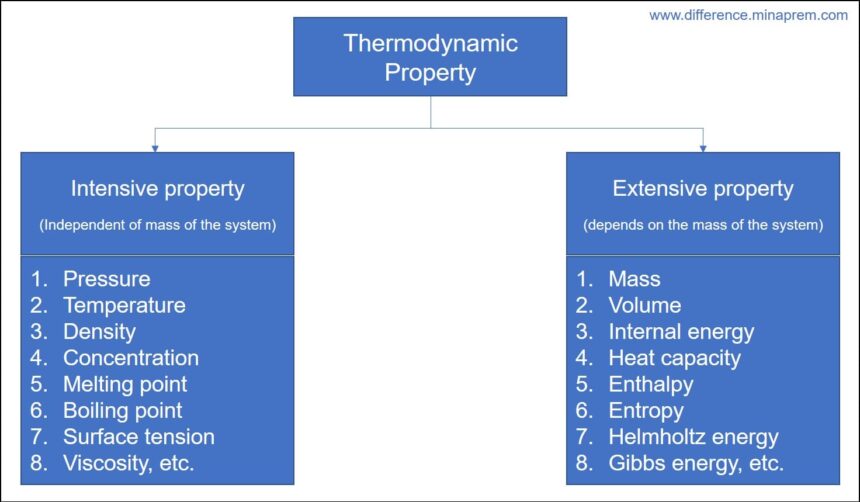
Common examples include temperature, density, and boiling point. For instance, water boils at 100°C no matter how much you have in the pot. Understanding these attributes is crucial for scientists and engineers alike.
In contrast to extensive properties, which depend on the size or mass of a sample—like volume and mass—intensive properties provide vital insights into material behavior under varying conditions.
They help identify substances and predict how they will react when combined with others. This understanding can lead to breakthroughs across various scientific disciplines and practical applications in everyday life.
Examples of Common Intensive Properties
Intensive properties are essential characteristics that remain unchanged regardless of the amount of substance present. These include temperature, density, and color.
Temperature is a classic example. No matter how much water you have, if it’s at 100 degrees Celsius, every drop shares that same thermal state.
Density also stands out in this category. It’s defined as mass per unit volume and remains constant for a given substance under specified conditions. For instance, gold’s density stays the same whether you hold a small nugget or an entire bar.
Another notable intensive property is boiling point. Water boils at 100 degrees Celsius at standard atmospheric pressure, no matter how much water is involved.
Solubility plays a role too; it describes how well one substance can dissolve in another at specific conditions—always unique to each material without regard to quantity.
Differences between Intensive and Extensive Properties
Intensive properties and extensive properties are essential concepts in understanding matter. Their differences lie primarily in how they respond to changes in the amount of material present.
Intensive properties remain constant regardless of sample size. For example, temperature and density are intensive. Whether you have a drop or a gallon of water, its temperature remains the same.
On the other hand, extensive properties depend on quantity. Mass and volume exemplify this category; doubling your substance will double these measurements.
This distinction is crucial in scientific calculations and experiments since it affects how we analyze materials under different conditions. Recognizing whether you’re dealing with an intensive or extensive property can guide decisions about measurement techniques and data interpretation effectively.
Importance of Measuring Intensive Properties in Science and Engineering
Measuring intensive properties is crucial in both science and engineering. These properties, such as temperature and pressure, remain constant regardless of the quantity of material present. This constancy allows scientists to understand substances more accurately.
In engineering, knowing the specific heat capacity or density can influence design decisions. It ensures that materials are chosen wisely for applications ranging from construction to manufacturing.
Intensive properties aid in identifying substance purity too. For instance, melting points can indicate if a compound is pure or contains impurities.
Furthermore, these measurements facilitate predictions about how materials will behave under different conditions. Understanding thermal conductivity helps engineers design better insulation systems.
The precise measurement of intensive properties supports innovation across various fields by enabling effective experimentation and analysis.
Relationship between Intensive Properties and State Functions
Intensive properties and state functions share a close relationship in thermodynamics. Both concepts help us understand the characteristics of matter without depending on the amount present.
State functions are properties that depend only on the current state of a system, regardless of how it reached that state. Examples include temperature, pressure, and volume. Intensive properties fall under this umbrella because they also remain constant when you change the size or quantity of material.
For instance, even if you take a small sample of water from a large body, its temperature remains unchanged. This consistency is what makes intensive properties particularly valuable for scientific calculations.
Understanding this connection helps scientists predict how substances will behave under different conditions without needing to analyze every detail about their quantity or composition. It streamlines research across various fields like chemistry and physics, enabling more efficient experimentation and analysis.
Real-life Applications of Intensive Properties
Intensive properties play a crucial role in various real-life applications. For instance, when designing chemical processes, knowing the boiling point or melting point of substances is vital. This information helps engineers select suitable materials for reactions.
In the culinary world, chefs utilize intensive properties like temperature and pH to create perfect dishes. Precise control over these factors ensures consistent quality in food preparation.
Material scientists rely on intensive properties such as density and hardness to develop new materials. These characteristics inform them about how a material will behave under different conditions.
Even environmental scientists use intensive properties to assess pollution levels in water bodies. Understanding the concentration of pollutants can lead to better management strategies for natural resources.
From cooking to engineering, intensive properties are essential tools that shape industries and influence everyday decisions.
Conclusion: The significance of intensive properties in understanding matter and its behavior
Intensive properties play a crucial role in our understanding of matter and its behavior. They are independent of the amount of material present, making them unique and vital for identifying substances. Properties such as temperature, density, and boiling point provide insights into how materials will react under various conditions.
These characteristics help scientists predict behaviors in chemical reactions or physical transformations. For engineers, knowing the intensive properties allows for designing systems that function efficiently under specific conditions.
In everyday life, we encounter intensive properties without realizing it. Whether it’s determining the right catalyst for a reaction or ensuring that materials can withstand high temperatures, these properties guide decision-making across numerous fields.
Recognizing their importance enhances our grasp of science and engineering principles. Understanding intensive properties is essential not just within laboratories but also in practical applications throughout various industries. Their significance cannot be overstated in both theoretical studies and real-world scenarios focused on innovation and efficiency.