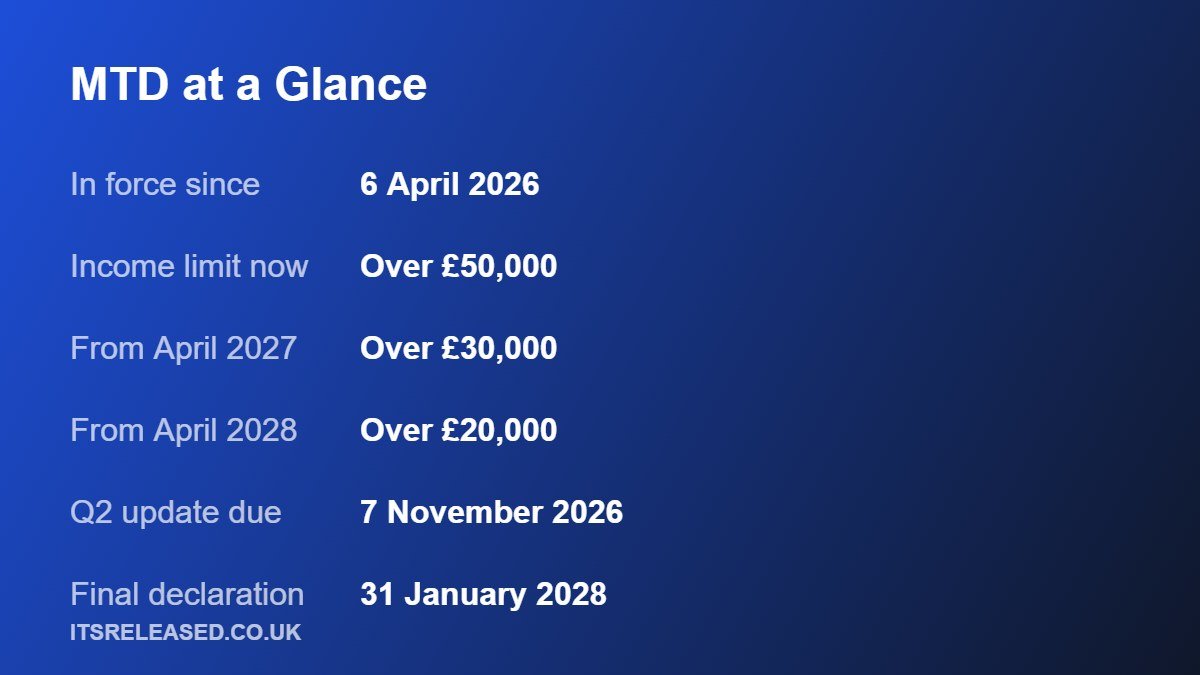
Making Tax Digital for Income Tax (MTD) went live on 6 April 2026. If you are a sole trader or landlord with qualifying income of more than £50,000, you now have to keep digital records and send HMRC four quarterly updates a year. The second update of the 2026/27 tax year is due by 7 November 2026, which is today for anyone reading this on the day it was published.
This guide lists every MTD deadline for 2026/27 and the years after it, shows who has to join and when, and explains how the new penalties work, including the soft landing that applies in the first year.
What Is Making Tax Digital for Income Tax?
MTD for Income Tax changes how self-employed people and landlords report to HMRC. Instead of one Self Assessment return a year, you keep your income and expenses in MTD-compatible software, send a quarterly update, and finish the year with a final declaration. The final declaration replaces the old tax return for anyone inside the scheme.

If you have only just started working for yourself, our guide to starting an online business from home in the UK covers the registration basics before MTD comes into play.
Who Has to Join MTD and When
MTD is being phased in by income. The test is your qualifying income: your combined gross income from self-employment and property, counted before expenses. Salary, pensions and dividends do not count towards it.
| Start date | Qualifying income | Income measured from |
|---|---|---|
| 6 April 2026 | Over £50,000 | 2024/25 tax year |
| 6 April 2027 | Over £30,000 | 2025/26 tax year |
| 6 April 2028 | Over £20,000 | 2026/27 tax year |
Partnerships are expected to join at a later date. You may be able to claim an exemption if it is not possible for you to use digital tools, for example because of a disability, age or where you live, but you need to apply to HMRC. If your income is below the limit today, you do not have to join yet, but the limit falls twice in the next two years, so it is worth preparing early.
MTD Quarterly Deadlines for 2026/27
Quarterly updates are due on the 7th of August, November, February and May. ICAEW points out that MTD updates are cumulative, so each one covers the tax year to date and not only the latest three months. Most people use the standard periods that follow the tax year, but you can choose calendar quarters instead.
More in Business
| Update | Standard period (cumulative) | Calendar-quarter option | Deadline |
|---|---|---|---|
| Quarter 1 | 6 April to 5 July 2026 | 1 April to 30 June 2026 | 7 August 2026 |
| Quarter 2 | 6 April to 5 October 2026 | 1 April to 30 September 2026 | 7 November 2026 |
| Quarter 3 | 6 April 2026 to 5 January 2027 | 1 April to 31 December 2026 | 7 February 2027 |
| Quarter 4 | 6 April 2026 to 5 April 2027 | 1 April 2026 to 31 March 2027 | 7 May 2027 |
| Final declaration | Whole 2026/27 tax year | Whole 2026/27 tax year | 31 January 2028 |
The 7 November deadline falls on a Saturday this year, so file as early as you can rather than leaving it to the last moment. You cannot send your final declaration for 2026/27 until all four quarterly updates have been filed, which is why a missed update still needs fixing.
MTD Deadlines for 2027/28 and 2028/29
The same four dates repeat every year. New groups join as the income limit falls.
| Tax year | Who joins | Quarterly deadlines | Final declaration |
|---|---|---|---|
| 2027/28 | Income over £30,000 (from 6 April 2027) | 7 Aug 2027, 7 Nov 2027, 7 Feb 2028, 7 May 2028 | 31 January 2029 |
| 2028/29 | Income over £20,000 (from 6 April 2028) | 7 Aug 2028, 7 Nov 2028, 7 Feb 2029, 7 May 2029 | 31 January 2030 |
What You Have to Do Each Quarter
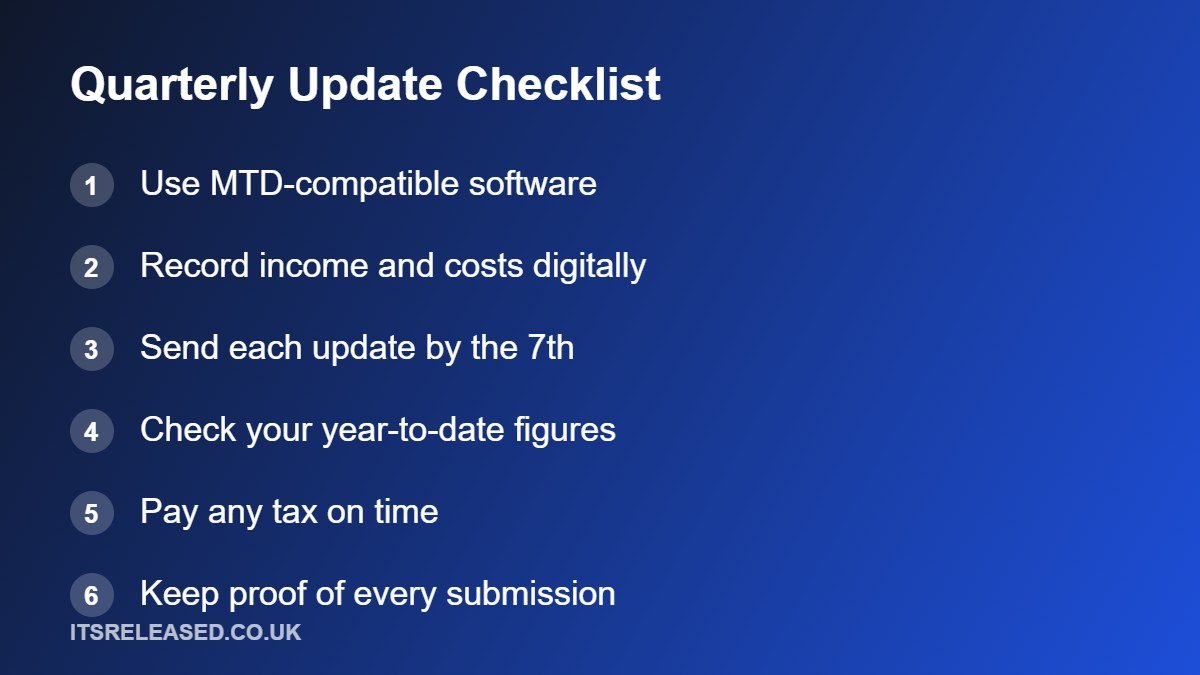
The routine is the same in every quarter. Record each sale, receipt and business expense in your software as it happens. At the end of the period, check the year-to-date figures and send the update to HMRC from the software. You do not need to work out your tax bill every quarter; the updates give HMRC a running picture, and your software can estimate what you may owe.
At the end of the year you add any adjustments and send the final declaration by 31 January, ten months after the tax year ends. For 2026/27 that date is 31 January 2028. Your 2025/26 return is still filed the usual way by 31 January 2027, so in early 2027 you will have both the old and the new routine running side by side.
Penalties: Late Submission Points
MTD uses a points system for late filing. Every missed deadline earns one point. When you reach the limit for how often you file, HMRC charges a £200 penalty, and a further £200 for each late filing after that while you stay at the limit.
| How often you must file | Points before a penalty | Penalty |
|---|---|---|
| Quarterly | 4 points | £200 |
| Annual | 2 points | £200 |
| Monthly | 5 points | £200 |
There is a soft landing in the first year. HMRC has said no penalty points will be given for late quarterly updates during 2026/27. The updates still have to be filed, and a late final declaration can still earn a point. From 2027/28, late quarterly updates count. Points normally expire after 24 months, and once you reach the limit you have to file on time for a set period (12 months for quarterly filers) to reset the count. VAT and Income Tax points are counted separately.
Penalties: Late Payment
Late payment is dealt with separately from late filing. Interest runs from the due date, and the penalty then builds up with time.
| How late the payment is | What HMRC charges |
|---|---|
| Up to 15 days (HMRC allows 30 days in 2026/27) | No penalty, but interest is charged from the due date |
| After the grace period | First penalty of 3% of the unpaid tax, then a second 3% about 15 days later |
| From day 31 | A further 10% a year, building up daily until you pay |
HMRC is giving extra time in the first year, so check the exact rules for your own bill on GOV.UK before relying on this table.
What to Do If You Miss a Deadline
Send the update as soon as you can. In 2026/27 you will not get a penalty point for a late quarterly update, and because updates are cumulative, sending the November update also covers everything that would have been in the August one. Do not wait for the next deadline. If there is a good reason for the delay, such as illness or a software failure, you can appeal a penalty to HMRC.
Frequently Asked Questions
When is the next MTD quarterly update due?
The second update for 2026/27 is due by 7 November 2026. After that come 7 February 2027 and 7 May 2027.
Do I need MTD if I earn under £50,000?
Not yet. The limit falls to £30,000 from April 2027 (based on your 2025/26 income) and to £20,000 from April 2028. If you are close to those figures, start looking at software now.
Does MTD replace my Self Assessment tax return?
Once you are inside MTD, the final declaration takes the place of the return. Your 2025/26 return is still filed the usual way by 31 January 2027, and the first final declaration, for 2026/27, is due by 31 January 2028.
Can I still use a spreadsheet?
Yes, if the spreadsheet is linked to MTD-compatible software or a bridging tool that sends the data to HMRC. If you use more than one package, the data must be linked digitally rather than copied by hand.
What counts as qualifying income?
Your gross income from self-employment and property combined, before any expenses. Employment income, pensions, dividends and interest are not included.
This guide reflects HMRC guidance and professional bodies’ summaries as of 7 November 2026. Rules and thresholds can change, and this is general information and not tax advice. Check GOV.UK or ask an accountant about your own position.