If you are trying to lose weight, the first question is always the same: how many calories are in the food on my plate? This desi food calorie chart lists rice, roti, salan, dal, salad, fruit chaat, snacks, drinks and sweets, with calories, protein, carbs and fat for a normal serving. Below the chart you will find a full worked example for a 31-year-old man who weighs 120 kg and is 5 ft 10 in tall: how many calories he burns, how many he should eat, and how much exercise he needs each day.
Every number here is an approximation. A roti made with a little ghee, a salan with a thick layer of oil, or a restaurant portion can change the total by 20 to 30 per cent, so treat the chart as a guide and not as a laboratory result.
How to Use This Calorie Chart
Calories are shown as kcal for the serving written next to each food. Cups and bowls refer to cooked food, and gram weights are the cooked weight. The biggest unknown in home cooking is oil. One tablespoon of cooking oil or ghee adds about 120 calories, which is why the same salan can be 150 calories one day and 300 the next depending on how much oil goes into the pot.

Three habits make the chart much more useful. Measure rice and salan with a cup or bowl for a week so you learn what one serving really looks like. Count oil, ghee, sugar and cream separately, because they are easy to forget. And add up the day before you eat, not after.
Desi Food Calorie Chart: Calories, Protein, Carbs and Fat
Here is the full chart, grouped by type of food. Use it to compare dishes, plan a day of meals, or check a snack before you eat it.
Rice and grains calories
| Food | Serving | Calories | Protein (g) | Carbs (g) | Fat (g) |
|---|---|---|---|---|---|
| White rice, boiled | 1 cup (160 g) | 205 | 4 | 45 | 0.5 |
| Basmati rice, boiled | 1 cup (160 g) | 200 | 4 | 44 | 0.5 |
| Brown rice, boiled | 1 cup (195 g) | 215 | 5 | 45 | 2 |
| Zeera rice | 1 cup (180 g) | 250 | 4.5 | 42 | 7 |
| Vegetable pulao | 1 cup (180 g) | 280 | 5 | 42 | 10 |
| Khichdi (rice and dal) | 1 bowl (200 g) | 230 | 8 | 38 | 5 |
| Chicken biryani | 1 plate (300 g) | 550 | 26 | 68 | 19 |
| Vegetable biryani | 1 plate (300 g) | 420 | 9 | 68 | 12 |
| Oats porridge made with water | 1 bowl (240 g) | 165 | 6 | 28 | 3.5 |
Breads calories
| Food | Serving | Calories | Protein (g) | Carbs (g) | Fat (g) |
|---|---|---|---|---|---|
| Roti / chapati, no ghee | 1 medium (40 g) | 115 | 3.5 | 18.5 | 3.5 |
| Phulka, no ghee | 1 small (30 g) | 85 | 2.5 | 16 | 1 |
| Roti with ghee | 1 medium + 1 tsp ghee | 155 | 3.5 | 18.5 | 8 |
| Tandoori roti | 1 piece (50 g) | 140 | 4.5 | 27 | 1.5 |
| Plain paratha | 1 medium (80 g) | 260 | 5 | 33 | 12 |
| Aloo paratha | 1 medium (110 g) | 300 | 6 | 40 | 13 |
| Naan, plain | 1 piece (90 g) | 290 | 9 | 50 | 6 |
| Puri, fried | 1 medium (30 g) | 120 | 2 | 14 | 6.5 |
| White bread | 1 slice (30 g) | 80 | 2.5 | 15 | 1 |
| Wholemeal bread | 1 slice (30 g) | 70 | 3 | 12 | 1 |
Dal and beans calories
| Food | Serving | Calories | Protein (g) | Carbs (g) | Fat (g) |
|---|---|---|---|---|---|
| Masoor dal with tadka | 1 bowl (200 g) | 210 | 12 | 28 | 5.5 |
| Moong dal with tadka | 1 bowl (200 g) | 190 | 12 | 24 | 5.5 |
| Chana dal | 1 bowl (200 g) | 250 | 13 | 34 | 7 |
| Dal makhani | 1 bowl (200 g) | 330 | 11 | 27 | 19 |
| Chana masala (chickpea curry) | 1 bowl (200 g) | 290 | 12 | 38 | 10 |
| Rajma (kidney bean curry) | 1 bowl (200 g) | 260 | 11 | 36 | 7 |
| Lobia (black-eyed pea curry) | 1 bowl (200 g) | 240 | 11 | 34 | 6 |
Meat, fish and eggs calories
| Food | Serving | Calories | Protein (g) | Carbs (g) | Fat (g) |
|---|---|---|---|---|---|
| Chicken curry, home style | 1 serving (200 g) | 300 | 24 | 8 | 19 |
| Chicken karahi | 1 serving (200 g) | 340 | 28 | 6 | 23 |
| Chicken korma | 1 serving (200 g) | 380 | 25 | 10 | 27 |
| Mutton or beef curry | 1 serving (200 g) | 390 | 26 | 6 | 29 |
| Nihari | 1 bowl (250 g) | 440 | 30 | 8 | 32 |
| Haleem | 1 bowl (250 g) | 330 | 20 | 28 | 15 |
| Fish curry | 1 serving (200 g) | 280 | 25 | 6 | 17 |
| Chicken tikka | 4 pieces (120 g) | 210 | 28 | 4 | 9 |
| Grilled chicken breast | 100 g cooked | 165 | 31 | 0 | 3.6 |
| Seekh kebab | 1 piece (50 g) | 110 | 8 | 2 | 8 |
| Chapli kebab | 1 piece (80 g) | 190 | 11 | 6 | 14 |
| Egg, boiled | 1 large | 78 | 6 | 0.6 | 5.3 |
| Egg, fried | 1 large | 90 | 6 | 0.4 | 7 |
| Omelette (2 eggs, 1 tsp oil) | 1 omelette | 200 | 13 | 2 | 15 |
Vegetable dishes calories
| Food | Serving | Calories | Protein (g) | Carbs (g) | Fat (g) |
|---|---|---|---|---|---|
| Aloo gobi | 1 bowl (200 g) | 200 | 5 | 25 | 9 |
| Aloo (potato) curry | 1 bowl (200 g) | 220 | 4 | 30 | 10 |
| Bhindi (okra) fry | 1 bowl (150 g) | 150 | 3 | 12 | 10 |
| Baingan bharta | 1 bowl (150 g) | 150 | 3 | 12 | 10 |
| Mixed vegetable curry | 1 bowl (200 g) | 160 | 4 | 18 | 8 |
| Saag (mustard greens) | 1 bowl (200 g) | 190 | 7 | 14 | 12 |
| Palak paneer | 1 bowl (200 g) | 300 | 13 | 10 | 24 |
| Paneer, plain | 100 g | 265 | 18 | 1.2 | 20 |
Salad and yoghurt calories
| Food | Serving | Calories | Protein (g) | Carbs (g) | Fat (g) |
|---|---|---|---|---|---|
| Kachumber salad (cucumber, tomato, onion) | 1 bowl (150 g) | 35 | 1.5 | 8 | 0.2 |
| Green salad with 1 tsp oil dressing | 1 bowl (150 g) | 70 | 1.5 | 7 | 4.5 |
| Cucumber | 100 g | 15 | 0.7 | 3.6 | 0.1 |
| Tomato | 1 medium (120 g) | 22 | 1 | 4.8 | 0.2 |
| Carrot | 1 medium (60 g) | 25 | 0.6 | 6 | 0.1 |
| Onion | 1 medium (110 g) | 44 | 1.2 | 10 | 0.1 |
| Raita (plain) | 1 bowl (100 g) | 60 | 3.5 | 5 | 3 |
| Plain yoghurt, full fat | 1 bowl (150 g) | 92 | 5 | 7 | 5 |
Fruit calories
| Food | Serving | Calories | Protein (g) | Carbs (g) | Fat (g) |
|---|---|---|---|---|---|
| Apple | 1 medium (180 g) | 95 | 0.5 | 25 | 0.3 |
| Banana | 1 medium (118 g) | 105 | 1.3 | 27 | 0.4 |
| Orange | 1 medium (130 g) | 62 | 1.2 | 15 | 0.2 |
| Mango, sliced | 1 cup (165 g) | 99 | 1.4 | 25 | 0.6 |
| Guava | 1 medium (100 g) | 68 | 2.6 | 14 | 1 |
| Grapes | 1 cup (150 g) | 104 | 1 | 27 | 0.2 |
| Watermelon | 1 cup (150 g) | 46 | 0.9 | 11.5 | 0.2 |
| Papaya | 1 cup (145 g) | 62 | 0.7 | 16 | 0.4 |
| Pomegranate seeds | 1/2 cup (87 g) | 72 | 1.5 | 16 | 1 |
| Pear | 1 medium (178 g) | 101 | 0.6 | 27 | 0.2 |
| Pineapple | 1 cup (165 g) | 82 | 0.9 | 22 | 0.2 |
| Strawberries | 1 cup (150 g) | 48 | 1 | 11.5 | 0.5 |
| Dates (Medjool) | 1 date (24 g) | 66 | 0.4 | 18 | 0 |
| Fruit chaat, no sugar or cream | 1 bowl (200 g) | 120 | 1.5 | 30 | 0.5 |
| Fruit chaat with sugar, cream or syrup | 1 bowl (200 g) | 260 | 3 | 40 | 9 |
Snacks and street food calories
| Food | Serving | Calories | Protein (g) | Carbs (g) | Fat (g) |
|---|---|---|---|---|---|
| Samosa, fried | 1 medium (80 g) | 230 | 4 | 24 | 13 |
| Pakora | 4 pieces (60 g) | 190 | 5 | 16 | 12 |
| Chana chaat | 1 bowl (150 g) | 200 | 9 | 30 | 5 |
| Pani puri | 6 pieces | 200 | 4 | 32 | 6 |
| Bun kebab | 1 burger | 400 | 16 | 42 | 18 |
| Chicken shawarma roll | 1 medium | 450 | 24 | 42 | 20 |
| French fries | 1 medium (117 g) | 365 | 4 | 48 | 17 |
| Digestive biscuit | 1 biscuit | 70 | 1 | 10 | 3 |
| Rusk | 1 piece | 40 | 1 | 7 | 1 |
Sweets calories
| Food | Serving | Calories | Protein (g) | Carbs (g) | Fat (g) |
|---|---|---|---|---|---|
| Gulab jamun | 1 piece (40 g) | 150 | 2 | 20 | 7 |
| Jalebi | 2 pieces (50 g) | 225 | 1.5 | 35 | 9 |
| Kheer | 1 bowl (150 g) | 250 | 6 | 38 | 8 |
| Gajar halwa | 1 small bowl (100 g) | 250 | 4 | 30 | 13 |
| Barfi | 1 piece (30 g) | 120 | 2 | 16 | 5.5 |
| Ice cream | 1 scoop (70 g) | 140 | 2 | 16 | 7 |
Drinks calories
| Food | Serving | Calories | Protein (g) | Carbs (g) | Fat (g) |
|---|---|---|---|---|---|
| Doodh patti chai (full-fat milk, 1 tsp sugar) | 1 cup (150 ml) | 90 | 3 | 10 | 4 |
| Black tea or green tea, no sugar | 1 cup | 2 | 0 | 0.5 | 0 |
| Full-fat milk | 1 glass (250 ml) | 150 | 8 | 12 | 8 |
| Skimmed milk | 1 glass (250 ml) | 85 | 8.5 | 12 | 0.2 |
| Sweet lassi | 1 glass (250 ml) | 220 | 6 | 34 | 6 |
| Salted lassi | 1 glass (250 ml) | 120 | 6 | 12 | 5 |
| Mango shake | 1 glass (300 ml) | 280 | 7 | 45 | 8 |
| Cola | 1 can (330 ml) | 140 | 0 | 35 | 0 |
| Fresh orange juice | 1 glass (250 ml) | 112 | 1.7 | 26 | 0.5 |
| Sugarcane juice | 1 glass (250 ml) | 180 | 0 | 45 | 0 |
| Nimbu pani with 2 tsp sugar | 1 glass (250 ml) | 45 | 0 | 11 | 0 |
Fats, nuts and extras calories
| Food | Serving | Calories | Protein (g) | Carbs (g) | Fat (g) |
|---|---|---|---|---|---|
| Cooking oil | 1 tbsp (14 g) | 120 | 0 | 0 | 14 |
| Desi ghee | 1 tbsp (14 g) | 123 | 0 | 0 | 14 |
| Butter | 1 tsp (5 g) | 36 | 0 | 0 | 4 |
| Sugar | 1 tsp (4 g) | 16 | 0 | 4 | 0 |
| Honey | 1 tsp (7 g) | 21 | 0 | 5.7 | 0 |
| Mayonnaise | 1 tbsp (14 g) | 94 | 0.1 | 0.1 | 10 |
| Peanuts | 1 handful (28 g) | 161 | 7 | 5 | 14 |
| Almonds | 10 nuts (12 g) | 70 | 2.5 | 2.6 | 6 |
| Cashews | 1 handful (28 g) | 157 | 5 | 9 | 12 |
| Walnuts | 1 handful (28 g) | 185 | 4.3 | 3.9 | 18.5 |
| Peanut butter | 1 tbsp (16 g) | 94 | 4 | 3 | 8 |
Quick Swaps That Save Calories
You do not have to give up the food you love. Small swaps remove a lot of calories without leaving you hungry. These all use numbers from the chart above.
| Instead of | Choose | Calories saved |
|---|---|---|
| Plain paratha (260) | Roti, no ghee (115) | 145 |
| Chicken biryani plate (550) | Chicken tikka (210) + kachumber salad (35) + 1 roti (115) = 360 | 190 |
| Mango shake (280) | 1 cup fresh mango slices (99) | 181 |
| Fruit chaat with sugar and cream (260) | Fruit chaat, no sugar (120) | 140 |
| Cola (140) | Water or unsweetened tea (about 2) | 138 |
| Mutton curry (390) | Fish curry (280) | 110 |
| Sweet lassi (220) | Salted lassi (120) | 100 |
| Roti with ghee (155) | Plain roti (115) | 40 |
Worked Example: A 31-Year-Old Man, 120 kg, 5 ft 10 in
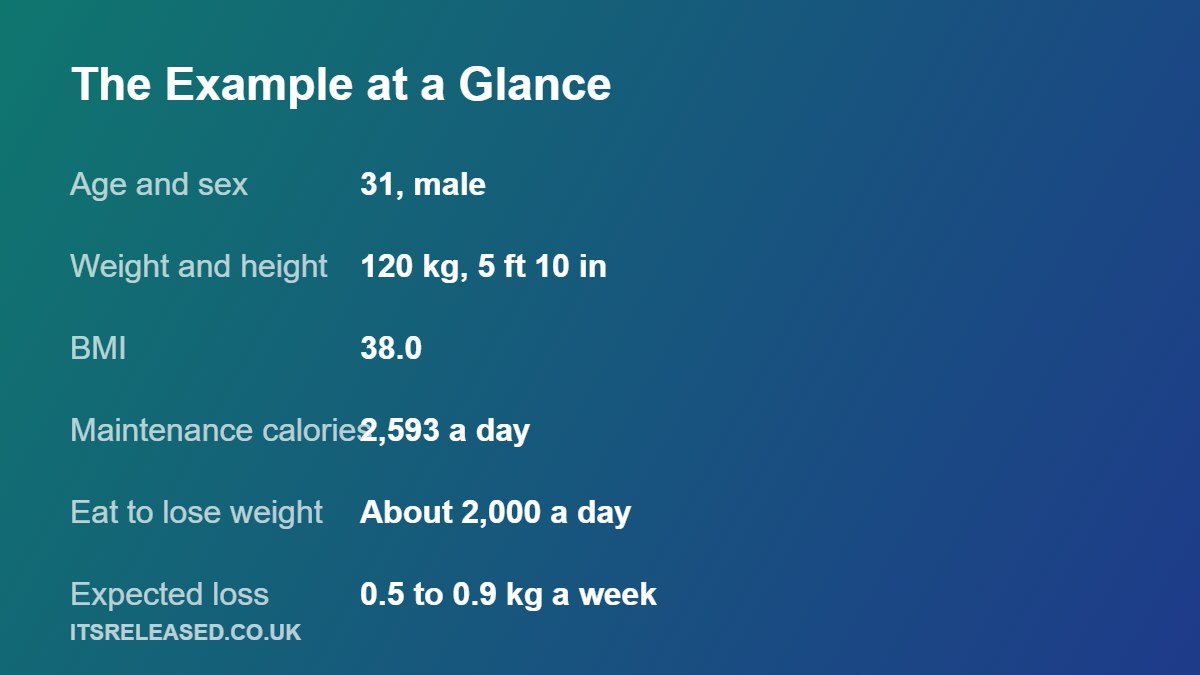
Take a real case: a man aged 31, weighing 120 kg and standing 5 ft 10 in (177.8 cm), who wants to lose weight. Here is the maths, one step at a time, so you can repeat it with your own age, weight and height.
More in Blogs
Step 1: Check the BMI
BMI is weight in kilograms divided by height in metres squared: 120 ÷ (1.778 × 1.778) = 38.0. On the NHS scale a BMI of 30 or more is obese and 40 or more is severely obese. If you are from a South Asian, Chinese, Middle Eastern, Black African or African-Caribbean background, health risk starts at a lower BMI, and NICE advises using 23 for overweight and 27.5 for obese. Either way, a BMI of 38 is a clear reason to start losing weight, and a clear reason to talk to a GP first. A healthy BMI at this height means a weight of about 59 to 79 kg.
Step 2: Work Out Resting Calories (BMR)
Your basal metabolic rate (BMR) is the energy your body burns just staying alive. The Mifflin-St Jeor equation for men is: (10 × weight in kg) + (6.25 × height in cm) − (5 × age) + 5. For our example: 1,200 + 1,111 − 155 + 5 = 2,161 calories a day. That is what he would burn lying in bed all day.
Step 3: Add Daily Activity to Get Maintenance Calories
Multiply BMR by an activity factor to get the calories needed to stay at the same weight.
| Activity level | Multiplier | Calories to stay at 120 kg |
|---|---|---|
| Sedentary (desk job, little exercise) | 1.2 | 2,593 |
| Lightly active (exercise 1 to 3 days a week) | 1.375 | 2,972 |
| Moderately active (exercise 3 to 5 days a week) | 1.55 | 3,350 |
| Very active (hard exercise 6 to 7 days a week) | 1.725 | 3,728 |
Most people overestimate how active they are. A man with a desk job who walks a little should start from the sedentary figure of about 2,593 calories. For comparison, the NHS gives 2,500 calories a day as the average for men.
Step 4: Choose the Daily Calorie Target
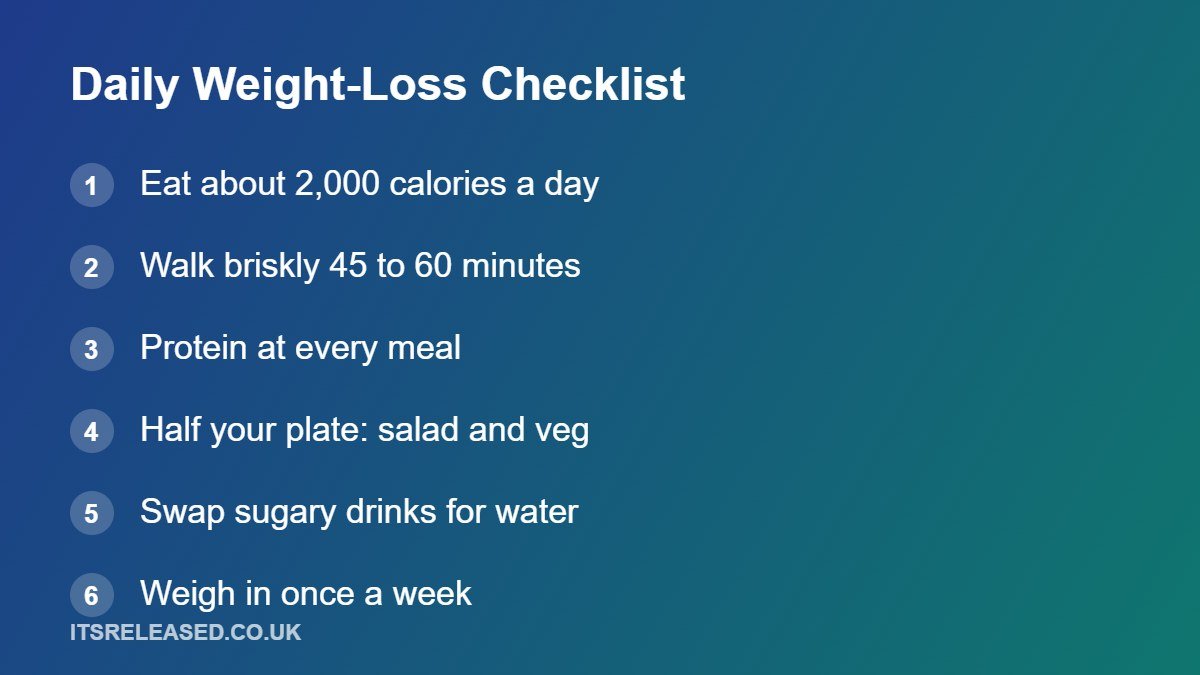
The NHS describes cutting about 600 calories a day as a safe and sustainable way to lose weight. So 2,593 − 600 = 1,993, and the target is about 2,000 calories a day. From food alone that is a loss of roughly 0.5 kg a week.
Do not go lower to speed things up. Below about 1,500 calories a day a man needs medical supervision, and very low calorie diets of around 800 calories are only for use under a doctor.
Step 5: Burn More With Exercise
Exercise adds to the deficit. The table shows the extra calories burned at 120 kg, worked out with the standard formula: (MET − 1) × body weight in kg × hours. MET values are approximate.
| Activity | Burned in 30 minutes | Burned in 60 minutes | Joint impact |
|---|---|---|---|
| Brisk walking (5.6 km/h) | 198 | 396 | Low |
| Walking, normal pace (4.8 km/h) | 150 | 300 | Low |
| Cycling, light (under 16 km/h) | 180 | 360 | Low |
| Cycling, moderate (16 to 19 km/h) | 348 | 696 | Low |
| Swimming, steady laps | 300 | 600 | None |
| Strength training, moderate | 150 | 300 | Low |
| Jogging (8 km/h) | 438 | 876 | High |
Heavier bodies burn more calories for the same activity, which is a small advantage at the start. Choose low-impact options such as walking, cycling and swimming to protect your knees, ankles and back. Jogging burns the most but is hard on the joints at this weight, so leave it until you have lost some.
Step 6: Put Food and Exercise Together
Here is what the three most realistic plans look like. About 7,700 calories of deficit equals roughly 1 kg of body fat.
| Plan | Eat (calories a day) | Exercise burn | Daily deficit | Loss per week | Loss per month |
|---|---|---|---|---|---|
| Food only | 1,990 | 0 | 604 | 0.55 kg | 2.4 kg |
| Food + 30 minutes brisk walk | 1,990 | 198 | 802 | 0.73 kg | 3.1 kg |
| Food + 60 minutes brisk walk | 1,990 | 396 | 1,000 | 0.91 kg | 3.9 kg |
All three sit inside the NHS advice of 0.5 to 1 kg lost per week. These are estimates: the scale also moves with water, salt and food still in the gut, so judge progress over two to four weeks and not day by day.
A Full Day of Eating on About 2,000 Calories
This sample day uses only foods from the chart. It comes to 2042 calories, so it fits the target with a little room to spare.
| Meal | Food and serving | Calories | Protein (g) | Carbs (g) | Fat (g) |
|---|---|---|---|---|---|
| Breakfast | Omelette (2 eggs, 1 tsp oil) (1 omelette) | 200 | 13 | 2 | 15 |
| Breakfast | Roti / chapati, no ghee (1 medium (40 g)) | 115 | 3.5 | 18.5 | 3.5 |
| Breakfast | Doodh patti chai (full-fat milk, 1 tsp sugar) (1 cup (150 ml)) | 90 | 3 | 10 | 4 |
| Mid-morning | Apple (1 medium (180 g)) | 95 | 0.5 | 25 | 0.3 |
| Mid-morning | Almonds (10 nuts (12 g)) | 70 | 2.5 | 2.6 | 6 |
| Lunch | White rice, boiled (1 cup (160 g)) | 205 | 4 | 45 | 0.5 |
| Lunch | Chicken curry, home style (1 serving (200 g)) | 300 | 24 | 8 | 19 |
| Lunch | Kachumber salad (cucumber, tomato, onion) (1 bowl (150 g)) | 35 | 1.5 | 8 | 0.2 |
| Lunch | Raita (plain) (1 bowl (100 g)) | 60 | 3.5 | 5 | 3 |
| Evening | Chana chaat (1 bowl (150 g)) | 200 | 9 | 30 | 5 |
| Evening | Black tea or green tea, no sugar (1 cup) | 2 | 0 | 0.5 | 0 |
| Dinner | 2 × Roti / chapati, no ghee (1 medium (40 g)) | 230 | 7 | 37 | 7 |
| Dinner | Masoor dal with tadka (1 bowl (200 g)) | 210 | 12 | 28 | 5.5 |
| Dinner | Mixed vegetable curry (1 bowl (200 g)) | 160 | 4 | 18 | 8 |
| Dinner | Green salad with 1 tsp oil dressing (1 bowl (150 g)) | 70 | 1.5 | 7 | 4.5 |
| Total | 2042 | 89 | 245 | 82 |
Protein is about 89 g (17% of calories), carbs 48% and fat 36%. If you feel hungry, add a second egg or a larger piece of chicken before you add more rice or roti, because protein keeps you full for longer. One cup of rice and three rotis across a whole day is a reasonable amount for someone losing weight. You do not need to cut either one out, only to watch the portion.
Weekly Exercise Plan for a Heavier Beginner
UK guidance for adults is at least 150 minutes of moderate activity a week plus strength work on two days. This plan goes a little beyond that, and every session is low impact. Start with shorter walks if 45 minutes feels like too much, and build up over a month.
| Day | Activity | Extra calories burned |
|---|---|---|
| Monday | Brisk walk, 45 minutes | 297 |
| Tuesday | Strength training, 30 minutes (bodyweight, bands or light weights) | 150 |
| Wednesday | Brisk walk, 45 minutes | 297 |
| Thursday | Swimming or cycling, 30 minutes | 300 |
| Friday | Brisk walk, 45 minutes | 297 |
| Saturday | Long brisk walk, 60 minutes | 396 |
| Sunday | Strength training, 30 minutes | 150 |
| Week | 225 minutes of aerobic activity + 2 strength sessions | 1,887 (about 270 a day) |
The extra burn averages about 270 calories a day. Combined with eating 1,990 calories, the daily deficit is around 870, which is about 0.8 kg of weight loss a week. If you work at a desk all day, short movement breaks add up too, and our guide to work from home productivity habits has easy ways to fit them in.
How Your Calorie Target Changes as You Lose Weight
A lighter body burns fewer calories, so the target has to be recalculated as you go. This table keeps the same 31-year-old man, the same height and the same 600-calorie deficit.
| Body weight | BMI | Resting calories (BMR) | Maintenance (desk job) | Eat with a 600 deficit |
|---|---|---|---|---|
| 120 kg | 38.0 | 2,161 | 2,593 | 1,993 |
| 110 kg | 34.8 | 2,061 | 2,474 | 1,874 |
| 100 kg | 31.6 | 1,961 | 2,354 | 1,754 |
| 90 kg | 28.5 | 1,861 | 2,234 | 1,634 |
| 80 kg | 25.3 | 1,761 | 2,114 | 1,514 |
Notice that around 80 to 90 kg the target falls close to 1,500 to 1,600 calories. At that point stop cutting food further. Add exercise, or accept a slower rate of loss, instead. Recalculate after every 5 kg lost. Even a loss of 5 to 10 per cent of starting weight (6 to 12 kg here) is widely linked with better blood pressure, blood sugar and joint comfort. Reaching the top of the healthy range of about 79 kg means losing around 41 kg, which at 0.7 to 0.8 kg a week takes roughly 12 to 18 months.
Safety First: See Your GP Before You Start
At a BMI of 38, speak to a GP before starting any new diet or exercise plan, especially if you have diabetes, high blood pressure, heart disease, sleep apnoea or joint pain. People on diabetes medicines may need those doses reviewed when they eat less. A GP can also tell you about NHS weight management services, which you may qualify for from a BMI of 30 (27.5 for people of South Asian background).
Stop exercising and get medical help if you have chest pain, severe breathlessness, dizziness or fainting. This article is general information and not medical advice. The numbers are a starting point, not a prescription.
Frequently Asked Questions
How many calories are in one roti?
A plain medium roti of about 40 g has roughly 115 calories, with 3.5 g of protein, 18.5 g of carbs and 3.5 g of fat. A small phulka is about 85 calories, and a roti with a teaspoon of ghee is about 155.
How many calories are in a cup of rice?
One cup (160 g) of boiled white rice has about 205 calories. Brown rice is about 215 calories per cup. A plate of chicken biryani can reach 550 calories, because of the oil and the meat.
How many calories should a 120 kg man eat to lose weight?
For a 31-year-old man who is 5 ft 10 in tall with a desk job, about 2,000 calories a day creates a 600-calorie deficit, which matches NHS advice. Add 30 to 60 minutes of brisk walking and the loss rises to about 0.7 to 0.9 kg a week. Everyone is different, so a GP or dietitian can fine-tune the number.
Is roti or rice better for weight loss?
Neither one is bad. A cup of boiled rice (205 calories) has about the same energy as two small rotis. Wholemeal roti brings a little more fibre. What matters more is the portion size you can stick to and filling half your plate with salad or vegetables.
Are fruits fattening?
Whole fruit is a good choice. An apple has about 95 calories and a cup of mango about 99, and the fibre and water make them filling. Watch fruit chaat made with sugar, cream or syrup (260 calories against 120 without) and juices, which are easy to drink in large amounts.
How much weight can I lose in a month?
At the NHS-recommended rate of 0.5 to 1 kg a week, that is about 2 to 4 kg a month. The first week or two can show a bigger drop because of water loss.
Can I lose weight by walking alone?
Walking helps. At 120 kg, one hour of brisk walking burns about 400 extra calories. But food controls most of the deficit, so the best results come from combining a calorie target with regular walking.
This guide is based on NHS calorie advice, NICE guidance on BMI thresholds, the Mifflin-St Jeor equation and standard MET values for exercise. Food values are approximate estimates for typical home-style servings.