Ferrari vehicles combine advanced engineering with electronic systems that continuously monitor engine performance, transmission behaviour, braking, suspension and other essential functions. When a warning light appears on the dashboard, it is important to understand what the message means and whether the vehicle requires immediate attention.
Some warnings indicate routine maintenance requirements, while others identify faults that may affect safety, reliability or mechanical performance. Ignoring these signals can result in further complications, particularly when an underlying electrical or mechanical issue remains unresolved.
Professional diagnostic assessment helps identify the reason behind an illuminated warning light rather than simply removing the notification.

For Ferrari owners, understanding dashboard warnings and the diagnostic process is an important part of responsible vehicle maintenance.
Understanding Ferrari Dashboard Warning Lights
Ferrari dashboard warning systems communicate information using illuminated symbols, text notifications and, on certain models, audible alerts.
Warning displays vary between generations. A Ferrari F430, 458 Italia and 488 GTB may present similar issues through different dashboard messages and electronic interfaces.
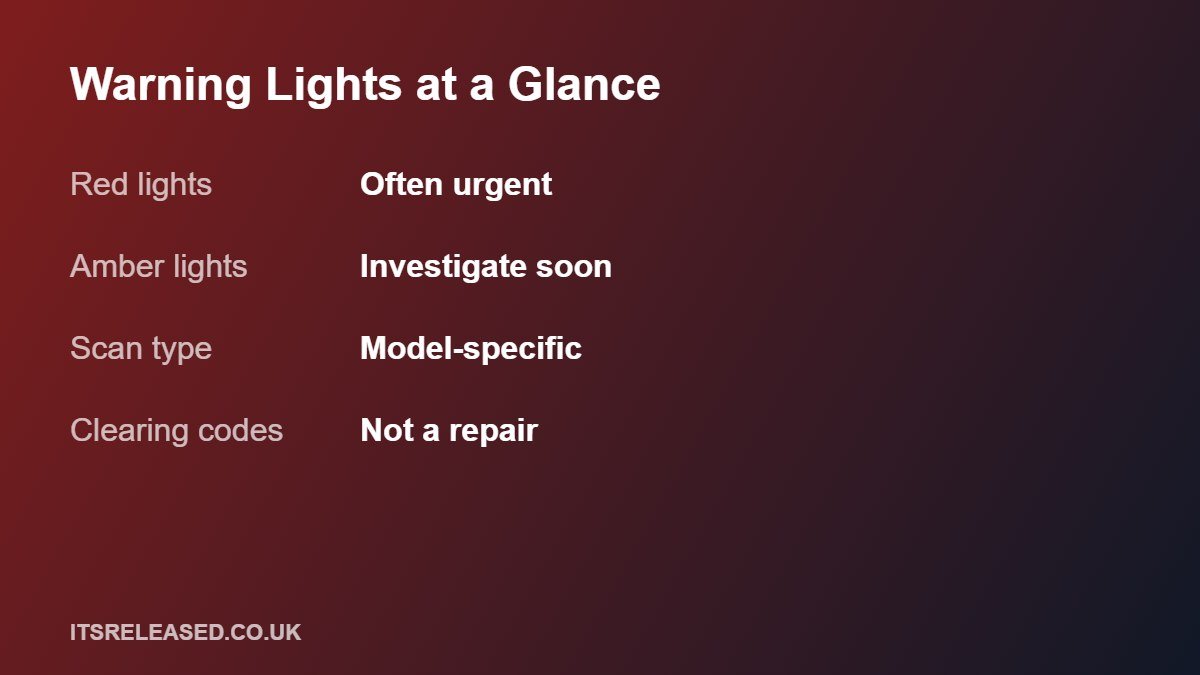
Red warning lights commonly indicate conditions requiring urgent attention, while amber notifications often identify systems that need investigation. However, the urgency depends on the specific message and model rather than colour alone.
More in Blogs
For example, low engine oil pressure, excessive engine temperature or certain braking system failures may require the driver to stop safely and switch off the engine.
Other notifications may relate to electronic stability systems, tyre pressure monitoring or maintenance schedules.
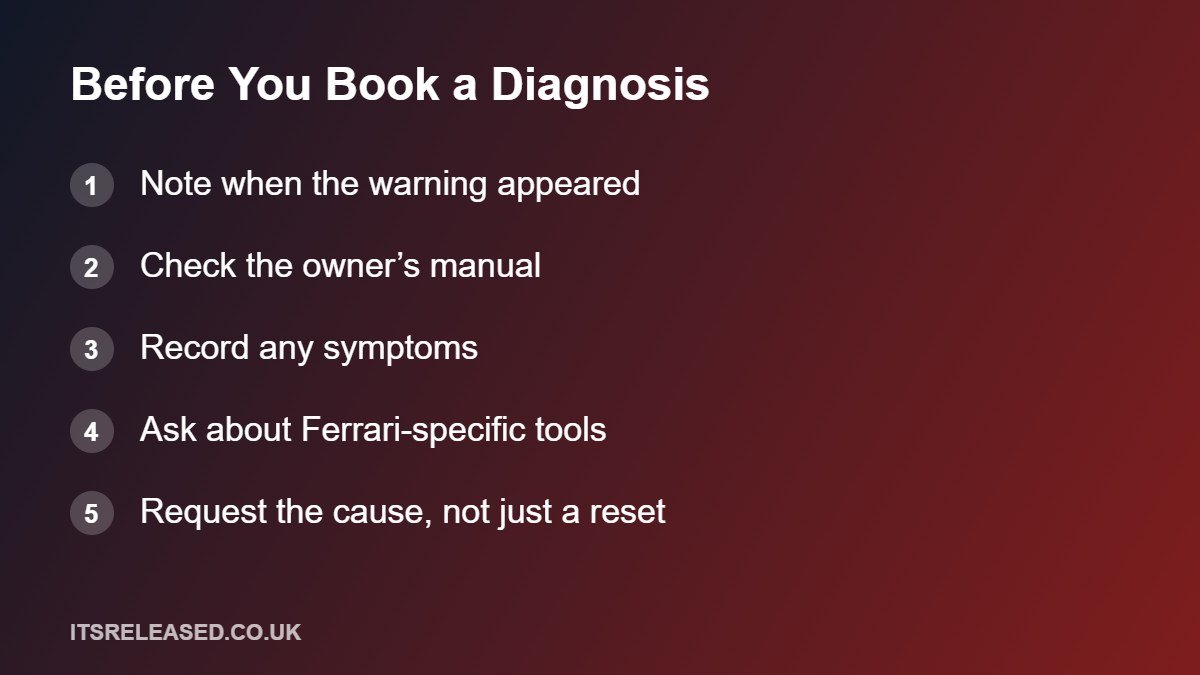
The owner’s manual should always be consulted when interpreting a warning, especially before deciding whether the vehicle can be driven.
Common Ferrari Engine Warning Lights
Engine management warnings are among the most concerning dashboard notifications for Ferrari owners.
Modern Ferrari engines depend on multiple sensors and electronic control units to manage combustion, fuel delivery, emissions and operating temperatures.
A warning may indicate problems involving:
- Oxygen sensors and emissions monitoring
- Ignition coils and spark plugs
- Fuel delivery components
- Engine temperature sensors
- Electronic throttle management
- Exhaust monitoring systems
- Wiring or electrical connections
A check engine warning does not automatically confirm a major engine failure. Nevertheless, it should never be dismissed without investigation.
For instance, an ignition system fault may cause incomplete combustion, hesitation or reduced engine performance. Continuing to drive with a significant misfire can also damage emission control components.
A diagnostic investigation establishes whether the problem involves an isolated component, an intermittent electrical issue or a wider mechanical concern.
Why Ferrari Warning Light Diagnosis London Matters
Searching for Ferrari Warning Light Diagnosis London often begins when a dashboard notification appears unexpectedly during driving or after the vehicle has remained parked for several weeks.
Ferrari vehicles may spend extended periods in storage, particularly during winter. Although the car is not being driven, electrical systems and battery condition still require attention.
Low battery voltage can contribute to electronic irregularities, especially during startup when multiple modules are activated simultaneously.
However, a battery-related warning should not automatically be attributed to a discharged battery. Charging system faults, wiring problems and individual control module failures may produce similar symptoms.
A systematic diagnostic approach helps separate temporary voltage-related events from persistent faults requiring repair.
This distinction is particularly important when several warning lights appear together, as a single electrical problem can sometimes affect multiple monitored systems.
Ferrari Gearbox and Transmission Warnings
Ferrari transmission systems incorporate electronic controls that monitor gear selection, clutch engagement and operating conditions.
On certain F1 transmission models, warning messages may indicate problems involving hydraulic pressure, clutch operation, gear selection or transmission control electronics.
Later dual-clutch Ferrari models use different transmission arrangements and therefore require model-specific diagnostic procedures.
Symptoms accompanying gearbox warnings may include delayed engagement, unusual shifting behaviour, restricted driving modes or difficulty selecting gears.
These symptoms should not be attributed to clutch wear without supporting evidence.
Diagnostic equipment can identify stored transmission faults and provide operating information that helps technicians determine the next investigation steps.
Where hydraulic or mechanical faults are suspected, electronic readings must be supported by appropriate physical checks.
A transmission warning that affects drive engagement or vehicle control should be treated as potentially serious.
Brake, ABS and Stability Control Warnings
Ferrari braking systems work alongside electronic stability and traction control systems to help maintain vehicle control.
Warnings may involve the anti-lock braking system, electronic stability control, brake wear monitoring or associated sensors.
An ABS warning may indicate that anti-lock functionality is unavailable even though conventional braking remains operational on some models.
However, combined warnings or changes in braking performance require particular caution.
Potential causes include wheel speed sensor faults, electrical connection problems or failures involving control components.
Brake-related warnings should never be cleared simply to remove a dashboard notification.
The underlying problem must be identified, and the operation of relevant safety systems should be verified after repairs.
Ferrari Suspension and Steering Warning Messages
Many Ferrari models incorporate electronically controlled suspension systems that monitor driving conditions and adjust damping behaviour.
Where fitted, suspension faults may involve electronic dampers, sensors, wiring or control modules.
Drivers may notice an illuminated suspension warning, unexpected changes in ride comfort or unusual vehicle behaviour.
Steering warnings may also appear when the vehicle detects problems affecting electronic assistance or related monitoring systems.
Because these systems contribute to vehicle control, diagnosing them requires more than a basic fault code scan.
A suitable investigation may involve live sensor readings, visual inspection, electrical testing and additional checks appropriate to the model.
The objective is to establish the actual cause rather than replace components based solely on the warning message.
How Ferrari Diagnostic Scanning Works
Modern diagnostic equipment communicates with electronic control units to retrieve fault information and assess system behaviour.
A diagnostic examination generally begins by recording the warning symptoms and identifying when the problem occurred.
Technicians may then review stored and current fault codes, evaluate live operating data and examine relevant electrical components.
The process may include checking:
- Battery and charging system voltage
- Engine sensor readings
- Electronic control module communication
- Transmission operating information
- Relevant wiring connections
- Warning recurrence after appropriate testing
Not every stored code represents an active problem.
Some faults may have occurred previously and remained in memory after the original condition disappeared.
Equally, intermittent faults can be difficult to reproduce during a short workshop visit.
Comparing electronic findings with the driver’s observations helps establish a more reliable understanding of the issue.
Can Ferrari Warning Lights Be Reset Without Repairs?
Although diagnostic equipment can clear certain stored fault codes, removing a warning notification does not necessarily resolve its cause.
If a defective sensor, electrical connection or mechanical problem remains present, the warning may return immediately or after further driving.
Repeatedly clearing codes without investigating them can also remove useful diagnostic information.
This may make intermittent problems harder to identify.
A suitable process involves diagnosing the fault, completing necessary repairs and confirming that the warning does not return under the relevant operating conditions.
Certain warning systems may require additional procedures after component replacement or software-related work.
The correct approach depends on the vehicle model and the system involved.
Finding a Ferrari Diagnostics Specialist Near Me
Owners searching for a Ferrari diagnostics specialist near me should consider whether the workshop has suitable equipment and experience with the specific Ferrari generation.
General diagnostic readers may retrieve certain engine-related codes but might not provide access to every manufacturer-specific system.
Ferrari models can contain separate modules governing the engine, gearbox, suspension, braking and other functions.
A workshop should therefore understand the differences between mechanical faults, electronic control issues and communication errors.
The ability to interpret results matters as much as obtaining them.
Diagnosis should explain the suspected cause, supporting evidence and any further testing required before major components are replaced.
This approach can reduce unnecessary expenditure and help owners understand the condition of their vehicles.
Preventing Repeated Ferrari Dashboard Warnings
Regular maintenance and appropriate storage practices can help reduce some warning-related problems.
Battery condition deserves attention, particularly for vehicles that are used infrequently. Maintaining a suitable charge helps support the electronic systems fitted to modern Ferrari models.
Scheduled inspections also provide opportunities to identify fluid leaks, ageing components, damaged wiring and other developing problems.
Owners should report occasional warning messages even when they disappear after restarting the vehicle.
A disappearing notification does not always mean the underlying condition has been resolved.
Recording when warnings appear, including driving conditions and accompanying symptoms, can be useful during diagnosis.
For older Ferrari models, inspection of electrical connections and maintenance history may be especially relevant.
Final Thoughts
Ferrari warning lights provide valuable information about the condition and operation of a vehicle, but their meanings vary between models and systems.
A dashboard notification should be interpreted using the owner’s manual, appropriate diagnostic equipment and evidence from the vehicle itself.
Ferrari Warning Light Diagnosis London is particularly relevant for owners experiencing engine management warnings, gearbox alerts, electrical irregularities or unexpected safety system notifications.
Understanding the cause of these warnings supports informed repair decisions, protects important vehicle systems and contributes to safer long-term ownership.