You can start an online business from home in the UK with modest costs, but the people who succeed usually do three things early: they test demand before spending, they understand their tax position, and they keep simple records from day one. This guide covers the practical steps in order. It is general information, not legal, tax or financial advice, and rules change, so always confirm the current position on GOV.UK or with a qualified adviser.
Step 1: Pick an Idea You Can Test Cheaply
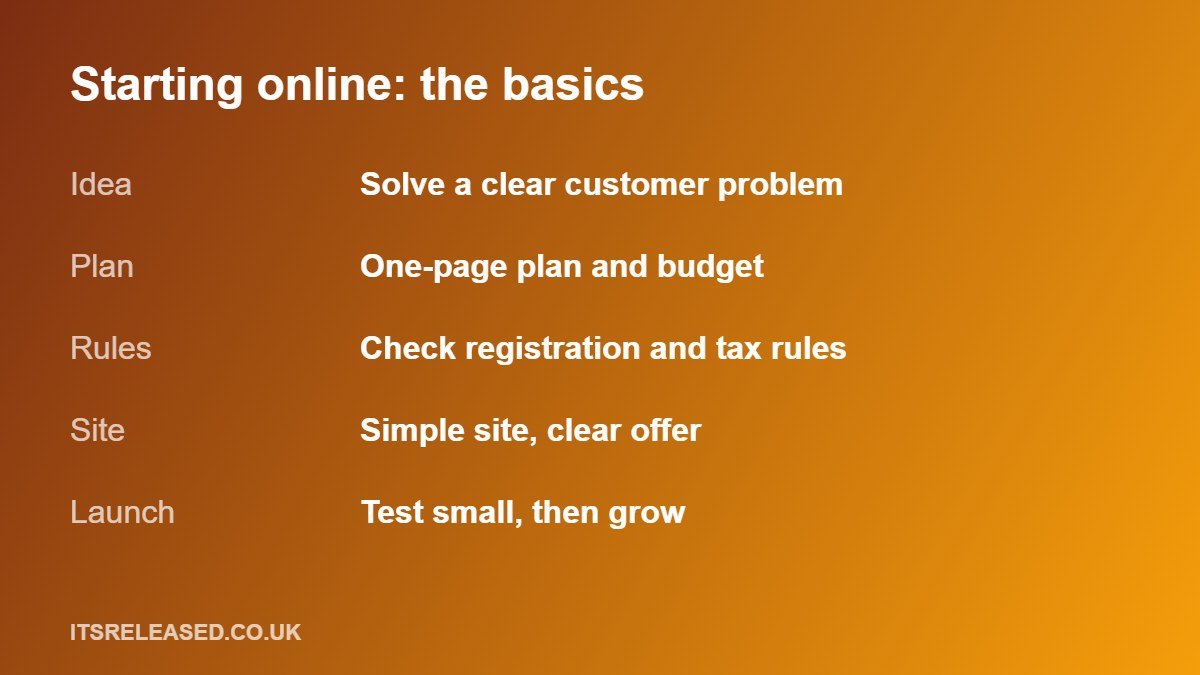
Strong first ideas usually sit where your skills meet a clear customer problem. Common starting points are services (design, tutoring, bookkeeping support, cleaning, repairs), digital products (templates, guides, courses) and physical goods (handmade items or resale). Ask four questions: who exactly is this for, what problem does it solve, why would they pay you rather than someone else, and can I reach them cheaply?
Test before you build. Message ten potential customers, post an offer in a relevant community, or run a small pre-order. A handful of real “yes, I would pay for that” answers is worth more than a polished website with no buyers.
Step 2: Choose a Business Model
| Model | How it works | Start-up cost | Main risk |
|---|---|---|---|
| Service | You sell your time or skill | Very low | Income depends on your hours |
| Digital product | You create once and sell repeatedly | Low | Hard to stand out without an audience |
| Own products | You make or buy stock to sell | Medium | Stock, storage and returns |
| Resale / dropshipping | You sell items sourced from others | Low to medium | Thin margins, supplier reliability |
Step 3: Write a One-Page Plan
Keep the plan short enough that you will actually use it. Our guide to the one-page business plan shows how to cover your customer, offer, pricing, marketing and goals on a single page.
Step 4: Work Out Your Costs and Price
List one-off costs (equipment, website, branding, initial stock) and monthly costs (software, marketing, delivery, platform fees, insurance). Then set a price that covers all of it and leaves a profit. A common beginner mistake is forgetting your own time, payment processing fees and returns. Use our startup budget guide to build a simple budget and track it monthly.
Check the Rules and Tax
This is the part many beginners skip. Points to check on GOV.UK or with an adviser:
- Self-employment and tax: if you trade as a sole trader, HMRC guidance says you may need to register for Self Assessment if your gross trading income goes over £1,000 in a tax year. There is a trading allowance of up to £1,000 that can apply to small income, but you cannot usually combine it with claiming your actual expenses for the same income, so choose carefully.
- Deadlines: if you are required to register, guidance states you must do so by 5 October following the end of the tax year in which you first had income. The UK tax year runs from 6 April to 5 April.
- Digital record keeping: HMRC’s Making Tax Digital for Income Tax is being phased in for sole traders and landlords above certain income levels, so check whether and when it applies to you.
- Limited company or sole trader: each has different tax, liability and paperwork. Ask an accountant before deciding.
- VAT: there is a registration threshold, so monitor your turnover.
- Consumer and data rules: if you sell to the public online, you have duties on refunds, clear pricing and information, and on protecting customer data.
- Working from home: check your lease or mortgage terms and home insurance. Simplified expenses for working from home exist for some sole traders, so ask about them.
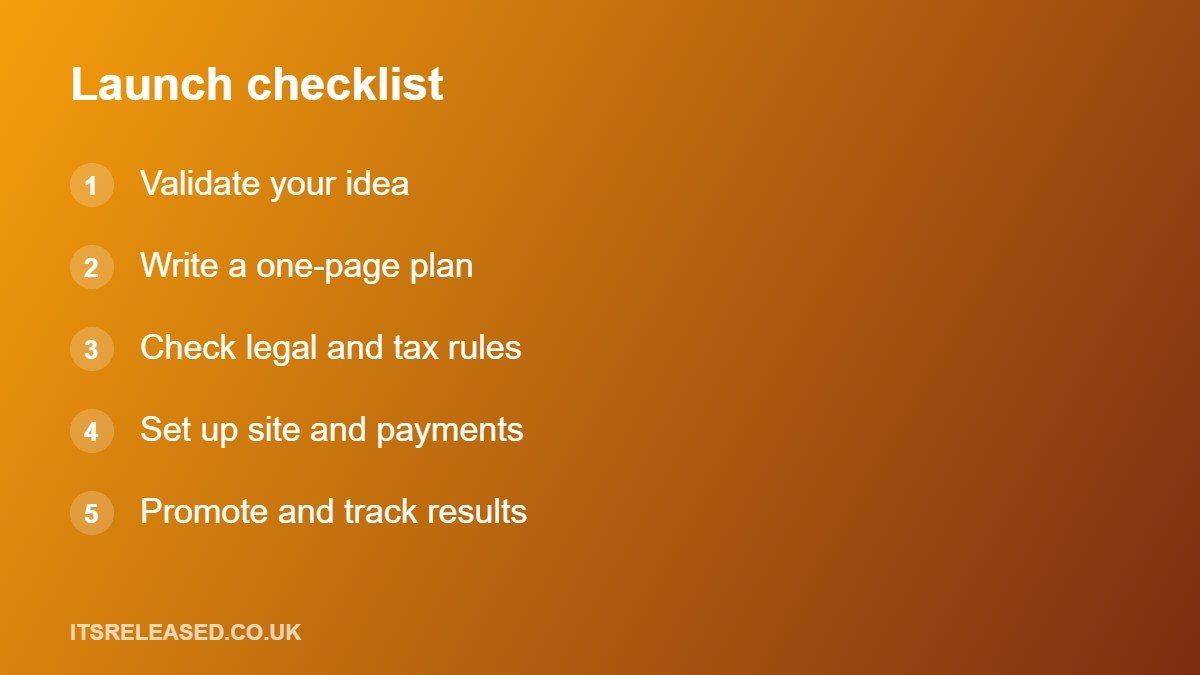
Step 5: Set Up a Simple Website and Payments
Your site only needs to explain what you offer, who it is for, prices (or how to get a quote), contact details, delivery and refund policies, and a privacy notice. Use a reputable payment provider and make sure the site uses HTTPS. Protect your own accounts with the steps in our cybersecurity basics and think about the equipment you need, as covered in our business laptop guide.
More in Business
Step 6: Get Your First Ten Customers
- Tell people you know, and ask them to introduce you to others who might need your service.
- Write helpful content that answers the questions your customers already ask.
- Use the one or two social platforms where your customers actually spend time.
- Offer a clear first purchase, such as a starter package or trial order.
- Collect honest reviews and examples of finished work.
A Simple 30-Day Launch Plan
| Week | Focus | Output |
|---|---|---|
| 1 | Idea and customer research | 10 conversations, one clear offer |
| 2 | Plan, pricing and budget | One-page plan, price list, cost sheet |
| 3 | Rules, accounts and basic site | Tax position checked, simple website, payment set up |
| 4 | First promotion | First outreach, first sale or pre-order |
Mistakes to Avoid
- Spending heavily before anyone has paid you.
- Ignoring tax until the deadline.
- Trying to sell to everyone instead of one clear audience.
- Believing promises of guaranteed fast income or “no work” systems.
- Mixing personal and business money without records.
Frequently Asked Questions
How much money do I need?
It depends on the model. A service business can start with very little, while a stock business needs more.
Do I need to tell HMRC straight away?
Not always. If your gross trading income stays under £1,000 in the tax year the trading allowance may cover it, but check the current guidance for your case.
Do I need a limited company?
Not necessarily. Many people start as sole traders. An accountant can advise on what suits you.
Can I do this alongside a job?
Many do, but check your employment contract and plan your time realistically.
How long until I earn?
There is no fixed answer. Treat the first months as a test and keep costs low.
Final Thoughts
Test your idea cheaply, write a simple plan, understand your tax position, and keep clear records from the start. A careful, steady launch usually beats a rushed one.