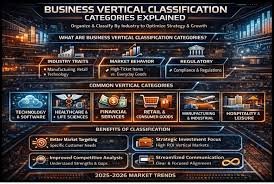
In today’s competitive market, businesses operate in a variety of industries and sectors. Understanding how to categorize businesses is essential for investors, regulators, analysts, and entrepreneurs. Business category classification methods are the structured systems used to organize companies into groups based on their activities, size, or market characteristics. Proper classification enables better benchmarking, informed decision-making, and streamlined industry analysis.
This article provides an in-depth guide to business category classification methods, explaining their importance, types, benefits, challenges, and practical applications for modern business management.
What Are Business Category Classification Methods?
Business category classification methods refer to systematic approaches used to group companies into categories based on shared characteristics. These classifications can be based on:
-
Industry or sector
-
Product or service type
-
Size or scale of operations
-
Market orientation or target customers
By applying these methods, organizations and analysts can compare businesses effectively, identify trends, and create actionable insights. For example, an investor analyzing the technology sector may classify companies into software development, hardware manufacturing, or IT services.
Classification is not only a tool for internal business planning but also plays a critical role in taxation, regulation, reporting, and market research. It allows government agencies, statistical offices, and research institutions to aggregate data and provide meaningful analyses.
Importance of Business Category Classification
Proper classification of businesses offers several advantages:
Enhanced Market Analysis
Classifying businesses enables analysts to examine market trends and industry growth patterns. Grouping companies by categories allows for easier comparison and identification of high-performing sectors.
Regulatory Compliance
Governments often require businesses to be classified for taxation, licensing, and reporting purposes. Accurate classification ensures compliance with local and international regulations.
Investment Decision-Making
Investors rely on business category classifications to identify suitable opportunities. By understanding which sector a company operates in, investors can evaluate risks, returns, and competitive positioning.
Improved Strategic Planning
Businesses themselves benefit from categorization. Classifying competitors and market participants helps companies identify gaps, benchmark performance, and design effective growth strategies.
Facilitates Economic Research
Statistical agencies use classification methods to track economic activity, employment trends, and production outputs across sectors. This information helps policymakers make data-driven decisions.
Major Business Category Classification Methods
There are several approaches to classifying businesses, depending on the criteria used. Below are the most common methods.
Industry-Based Classification
Industry-based classification organizes businesses based on the primary economic activity in which they operate. This method is widely used in economic research, investment analysis, and reporting.
Standard Industrial Classification (SIC)
The SIC system was developed to standardize business categories for statistical purposes. It assigns a four-digit code to businesses based on their main line of activity. For example, 7372 represents prepackaged software companies. SIC allows analysts to compare similar companies across regions and over time.
North American Industry Classification System (NAICS)
NAICS is a more modern alternative to SIC and is used primarily in the United States, Canada, and Mexico. It provides a hierarchical structure with six levels of classification, from broad sectors to detailed industry groups. NAICS is particularly useful for large-scale economic analysis and regulatory reporting.
Product or Service-Based Classification
This method categorizes businesses according to the goods or services they offer. It is particularly useful for marketing, sales analysis, and competitive benchmarking.
Consumer vs. Industrial Products
Businesses can be divided into those that supply consumer goods (directly to individuals) and industrial goods (used in production or operations). For example, a clothing brand falls under consumer products, while a steel manufacturer is categorized as industrial products.
Tangible vs. Intangible Products
Tangible products are physical items like machinery, electronics, or furniture, while intangible products include services, digital solutions, and intellectual property. This classification helps organizations evaluate production, delivery methods, and market needs.
Size-Based Classification
Size-based classification groups businesses based on metrics such as revenue, number of employees, or market share. This approach is particularly important for regulatory purposes, financial analysis, and resource allocation.
Micro, Small, Medium, and Large Enterprises
Governments often use criteria like employee count or annual revenue to classify businesses. Micro enterprises might have fewer than 10 employees, small enterprises 10–50, medium enterprises 50–250, and large enterprises over 250 employees.
Startup vs. Established Businesses
Startups are newly established businesses with high growth potential, whereas established businesses have a stable market presence. This classification aids investors and accelerators in targeting appropriate funding and support.
Market Orientation Classification
Businesses can also be classified according to their target markets and business models. This method provides insights into strategic positioning and customer segmentation.
B2B (Business-to-Business)
These companies sell products or services primarily to other businesses. Examples include wholesale suppliers, industrial equipment manufacturers, and software service providers.
B2C (Business-to-Consumer)
B2C businesses sell directly to end consumers. Retail chains, online marketplaces, and restaurants fall into this category.
B2G (Business-to-Government)
B2G companies provide products or services to government agencies. Contractors, defense suppliers, and public service providers are typical examples.
Hybrid Classification Methods
Many modern businesses operate in multiple sectors or offer diverse products. Hybrid classification combines multiple methods—industry, product, size, and market orientation—to provide a comprehensive understanding.
Case Example: Technology Firms
A software-as-a-service (SaaS) company may be classified as:
-
Industry: Information Technology
-
Product: Software (Intangible)
-
Size: Medium Enterprise
-
Market: B2B
Hybrid classification allows investors, analysts, and regulators to evaluate such businesses from multiple perspectives.
Benefits of Using Business Category Classification Methods
Using structured classification systems provides numerous advantages:
Better Decision-Making
Accurate business classification allows stakeholders to make informed decisions regarding investments, partnerships, and strategic planning.
Streamlined Reporting
Classification simplifies reporting for regulatory compliance, taxation, and corporate governance, reducing errors and ensuring consistency.
Enhanced Market Research
Segmenting businesses into categories allows analysts to identify trends, understand competitive landscapes, and target research effectively.
Facilitates Resource Allocation
Governments and financial institutions can allocate resources, grants, and support programs more effectively when businesses are classified systematically.
Benchmarking and Performance Evaluation
Companies can compare their performance against peers within the same category, identifying strengths and areas for improvement.
Challenges in Business Classification
While classification provides many benefits, it also presents challenges:
-
Ambiguity in Operations: Some businesses operate in multiple industries, making single-category classification difficult.
-
Dynamic Business Models: Rapidly evolving markets and technology make static classifications outdated quickly.
-
Data Limitations: Incomplete or inaccurate business data can lead to misclassification.
-
International Differences: Classification systems like SIC and NAICS may differ across countries, complicating cross-border analysis.
Addressing these challenges requires flexible, updated, and hybrid classification approaches.
Future Trends in Business Category Classification
The evolution of industries and technology is driving new methods for classification:
AI and Machine Learning
Artificial intelligence can analyze business data, automatically identifying categories based on patterns, operations, and financial metrics.
Dynamic Classification Systems
Cloud-based platforms allow businesses to update their classification in real-time, reflecting changes in products, markets, or operations.
Global Standardization
Efforts are underway to harmonize classification systems internationally, facilitating trade, investment, and regulatory compliance.
Data-Driven Insights
Integration of big data enables detailed market segmentation, competitor analysis, and industry forecasting using classification methods.
Conclusion
Business category classification methods are essential tools for organizing, analyzing, and understanding companies in a systematic way. Whether through industry, product, size, market orientation, or hybrid approaches, classification allows businesses, investors, regulators, and researchers to make informed decisions, benchmark performance, and identify trends.
As markets evolve, classification methods will continue to adapt, leveraging AI, real-time data, and international standardization. Understanding these methods not only helps businesses position themselves strategically but also enhances overall economic analysis, policymaking, and resource allocation.
For companies, adopting a clear understanding of business category classification methods ensures better strategic planning, operational efficiency, and competitive advantage in a rapidly changing global market.