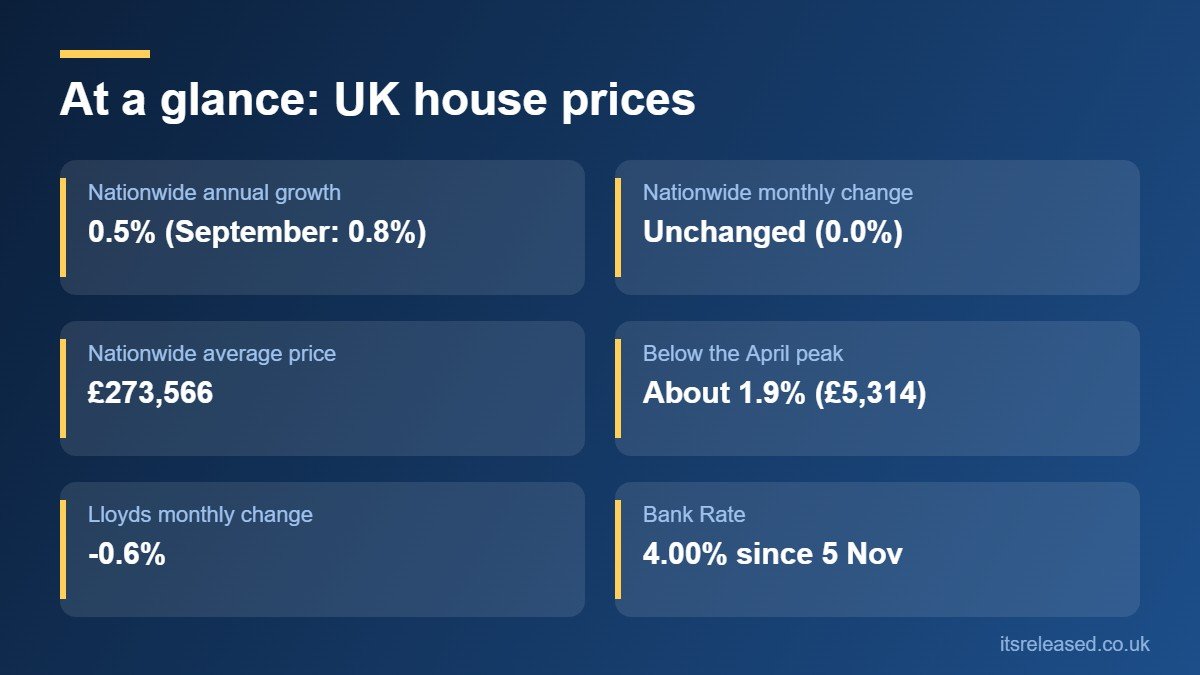
UK house prices were flat in October 2026 on Nationwide’s index, and annual growth slowed to 0.5%, the weakest pace since January 2024. Nationwide put the average UK home at £273,566, down from £274,251 in September. Lloyds, which used to publish the Halifax index, reported a bigger fall of 0.6% over the month. So are prices dropping? It depends which measure you read, and the honest answer is that the market is soft rather than collapsing.
This guide sets out the latest figures from Nationwide, Lloyds, Rightmove and Zoopla side by side, explains why they disagree, looks at what is pushing prices around, and covers what it means for buyers, sellers and homeowners. It is general information rather than financial advice.
What Nationwide’s October 2026 House Price Index Says
| Measure | October 2026 | September 2026 |
|---|---|---|
| Annual house price growth | 0.5% | 0.8% |
| Monthly change (seasonally adjusted) | 0.0% (unchanged) | -0.3% |
| Average price | £273,566 | £274,251 |
| Three-month change | -0.2% | Not stated |
Annual growth of 0.5% is the slowest since January 2024, according to Nationwide’s own release. The Financial Times, as reported by Digg, noted that the average price is now below its April peak of £278,880. That is a gap of £5,314, or roughly 1.9%, which I calculated from the two figures.
So Are UK House Prices Falling?
Search interest in a “Nationwide property price drop” has been high this week, and the language is understandable, but the data supports a more careful reading:
- Over the month: flat on Nationwide’s seasonally adjusted measure, after a fall of 0.3% in September.
- Over the year: still up 0.5%, so the average home costs slightly more than it did a year ago.
- Since the spring: about 1.9% below the April peak on Nationwide’s average price, which is not seasonally adjusted, so some of that gap reflects normal seasonal patterns.
In short, prices have stopped rising, edged back from their high and are now going sideways to slightly down, depending on the index.
Nationwide, Lloyds, Rightmove and Zoopla Compared
Different indices measure different things, so their headline numbers rarely match. Nationwide’s index uses its own mortgage data at the approval stage. Rightmove tracks the prices sellers ask for when they list a home, which is why it can move differently from prices agreed in a sale. The table below uses the latest figures reported by each source, with Rightmove and Zoopla figures as collated by Which?.
| Index | Latest month | Monthly change | Annual change |
|---|---|---|---|
| Nationwide | October 2026 | 0.0% | +0.5% |
| Lloyds (formerly Halifax) | October 2026 | -0.6% (after -0.1% in September) | Not covered here |
| Rightmove (asking prices) | October 2026 | +1.0% | -0.1% |
| Zoopla | September 2026 | 0.0% | +0.8% |
The mixed picture is the message. Lloyds shows a clear monthly fall, Nationwide shows a pause, and Rightmove’s asking prices rose in the month but are slightly lower than a year ago. None of them shows a sharp crash, and none shows a boom.
More in Finance
Why Are House Prices Soft?
Higher mortgage rates
Borrowing costs are the main brake. The Bank of England raised Bank Rate to 4% on 5 November, and fixed rates had already climbed ahead of the move: Moneyfacts data reported by Mortgage Professional put the average two-year fix at 5.97% and the five-year fix at 6.00% in November, against 5.01% for the five-year a year earlier. We explain what the decision means for homeowners in our guide to the Bank of England rate rise to 4%.
An energy-price shock and weak confidence
Nationwide’s chief economist pointed to higher energy prices from the conflict in the Middle East, which are adding to inflation worries and to expectations of further Bank Rate rises. He also cited weak buyer enquiries and a noticeable drop in consumer sentiment, and expects further near-term softness. For the household bills angle, see our guide to the energy price cap from January 2027.
The cushions that remain
The same Nationwide commentary lists reasons the market is not in freefall: income growth has been outpacing house price growth by a wide margin, which has improved affordability over the past two years, although higher rates have partly reversed that. The economy is described as resilient, employment is stable, and household debt relative to income is near 20-year lows. Nationwide’s view is that the market can regain momentum once the energy shock fades.
What the Forecasters Expect for 2026
Which? collates forecasts from the major players. Treat them as snapshots, because they get revised as the data moves.
| Forecaster | 2026 house price forecast | When updated |
|---|---|---|
| Savills | Fall of about 2% | Early June |
| Rightmove | Between 0% and a 2% fall | August |
| Zoopla | Rise of about 1% | Reduced from an earlier forecast |
What It Means for Buyers, Sellers and Homeowners
If you are buying
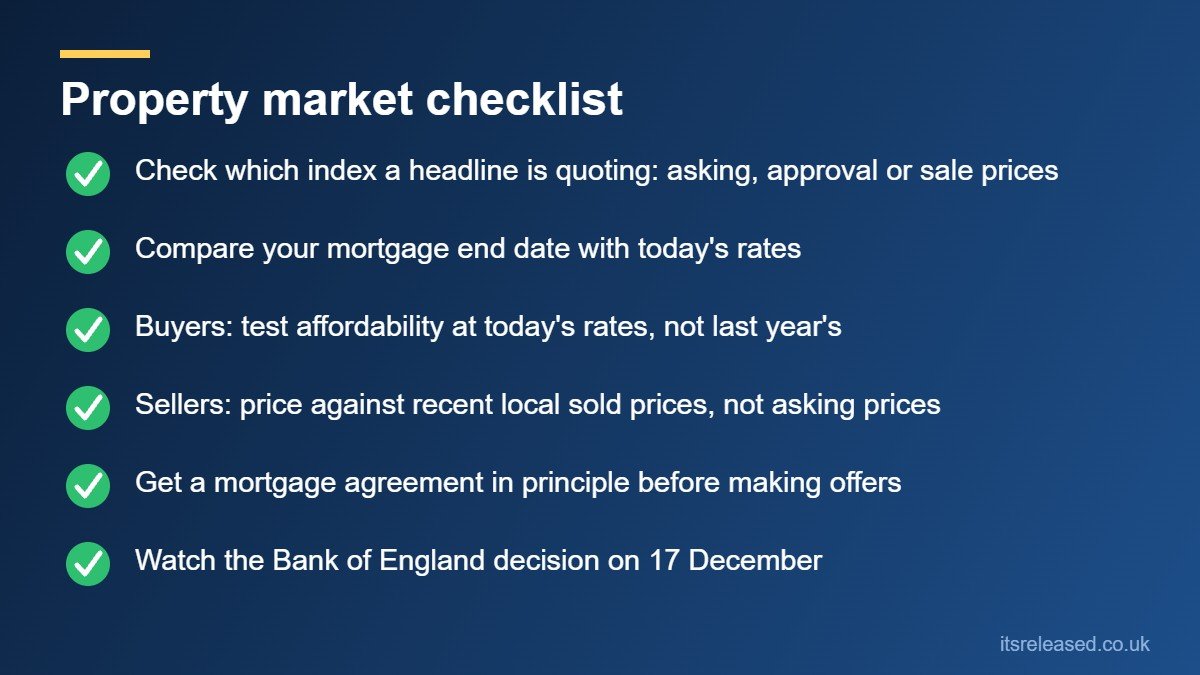
A flat market gives buyers more room to negotiate, but the bigger issue is the monthly payment. Test what you can afford at today’s mortgage rates rather than last year’s, and get an agreement in principle from a lender before you make offers, so sellers take you seriously.
If you are selling
Price against recent sold prices in your street rather than against asking prices on listing sites, because asking prices can run ahead of what buyers actually pay. Realistic pricing from day one usually beats a high price followed by repeated reductions.
If you are a homeowner
For most owners, a fall of a percent or two on paper changes little unless they plan to sell or remortgage at a high loan-to-value. The bigger question is the cost of your next mortgage deal, so note when your current one ends and look at your options early.
What to Watch Next
- Nationwide and Lloyds monthly indices for November, published near the start of December.
- The Bank of England decision on Thursday 17 December 2026, which will show whether Bank Rate keeps rising.
- Energy prices and the Middle East conflict, which Nationwide and the Bank both flag as drivers of inflation and rates.
- Forecast revisions from Savills, Rightmove and Zoopla as the year ends.
Frequently Asked Questions
Are UK house prices falling?
Prices are soft rather than falling sharply. Nationwide shows them flat in October and up 0.5% on the year, while Lloyds shows a 0.6% monthly fall. Nationwide’s average price is about 1.9% below its April peak.
What is the average UK house price?
Nationwide’s average was £273,566 in October 2026. Other indices use different methods and give different averages.
Why do house price indices disagree?
They measure different things. Some use mortgage approval data, some use asking prices on listings, and official figures based on completed sales arrive later. Differences in timing, sample and seasonal adjustment all add to the gaps.
Will house prices fall in 2027?
Nobody knows. Nationwide expects near-term softness and a possible recovery once the energy shock fades, but forecasts for 2026 alone range from a 2% fall to a 1% rise, so any 2027 call is highly uncertain.
Is now a good time to buy a house in the UK?
That depends on your finances, how long you plan to stay and the mortgage rate you can get, not on a single month’s index. A regulated mortgage adviser can look at your situation, and this guide cannot.
What is the Nationwide House Price Index?
It is a monthly measure of UK house prices produced by Nationwide Building Society from its own mortgage lending data at the approval stage, published near the start of each month.
The Bottom Line
October’s figures describe a stalled market, not a crash. Annual growth of 0.5% is the weakest in almost three years, the average price is about 1.9% below the spring peak, and the main drivers are expensive mortgages and shaky confidence. Whether prices recover depends largely on inflation, energy prices and the path of interest rates, so the 17 December Bank of England decision is the next date worth watching.
Sources consulted: Nationwide House Price Index (October 2026), the Lloyds House Price Index, Which?, the Financial Times (as reported by Digg), Mortgage Professional (Moneyfacts data) and Mortgage One.