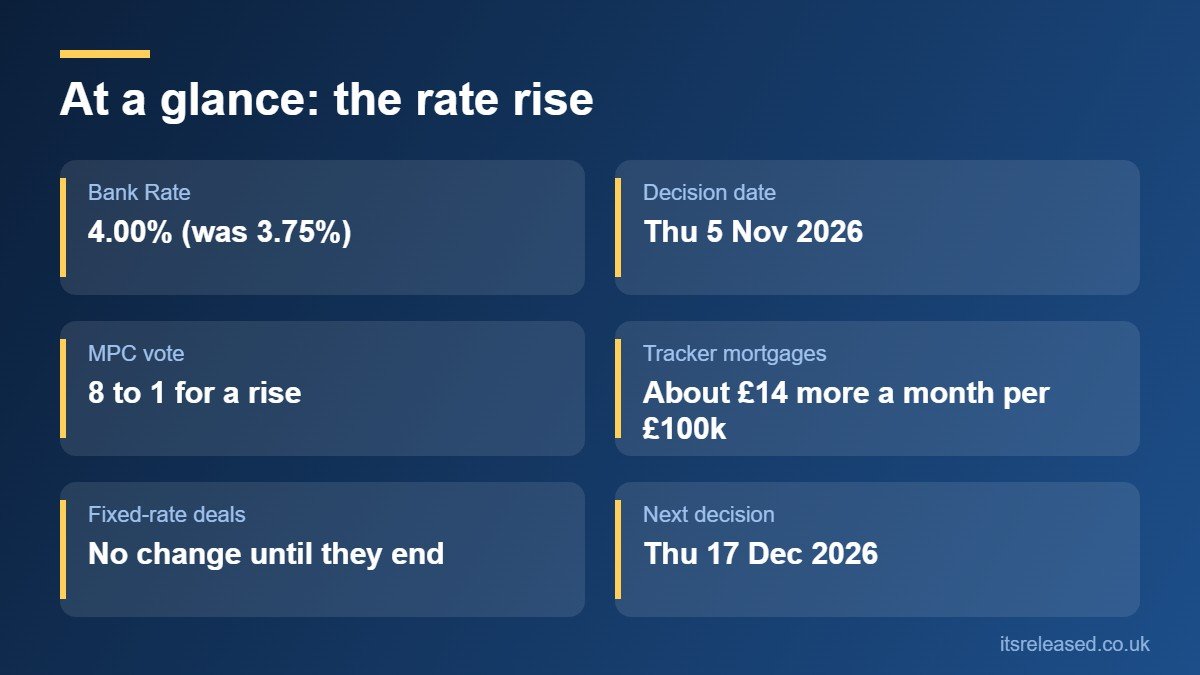
The Bank of England raised Bank Rate from 3.75% to 4% on Thursday 5 November 2026, its first increase since August 2023. According to Mortgage One’s summary of the decision, the Monetary Policy Committee voted 8 to 1, with eight members backing a quarter-point rise and Catherine Mann voting for a bigger half-point move to 4.25%. If you have a tracker or variable-rate mortgage, your payments are heading up by the full 0.25 points. If you are on a fixed deal, nothing changes until it ends.
This guide explains the decision in plain English: what the Bank said and why, what the rise costs on a typical mortgage, what it means for savers and borrowers, and when the next decisions are due. It is general information, not personal financial advice, so check your own mortgage terms or speak to a regulated adviser before making a decision.
What the Bank of England Decided on 5 November 2026
| Item | Detail |
|---|---|
| Decision | Bank Rate raised by 0.25 percentage points, from 3.75% to 4.00% |
| Date | Thursday 5 November 2026 |
| Vote | 8 to 1 for a quarter-point rise. Catherine Mann voted for 0.5 points (4.25%). No member voted to hold. |
| Last increase | August 2023, when Bank Rate reached 5.25% |
| Previous move | A cut to 3.75% in December 2025, followed by holds through 2026 |
| September 2026 meeting | Held at 3.75% by 6 votes to 3, with three members already voting for 4% |
| Next decisions | 17 December 2026, then 4 February 2027, 18 March 2027 and 29 April 2027 |
Why Did the Bank Raise Rates?
The short answer is inflation. Mortgage One reports that CPI inflation was 3.5% in September, well above the Bank’s 2% target, and that the Bank expects it to climb towards about 5% by mid-2027. Higher energy prices linked to the conflict in the Middle East are a major reason. Nationwide’s chief economist made the same point in the building society’s October house price report, saying market expectations of Bank Rate rises had already kept market interest rates high.

The Governor was reported as saying the rise is unlikely to be the last unless the conflict is resolved. Markets agree: on 3 November, before the decision, market pricing implied Bank Rate somewhere around 4.8% by late 2027, according to Mortgage One. That is a market expectation, not a Bank of England forecast, and it can change quickly. For the household energy side of the story, see our guide to the energy price cap from January 2027.
What It Means for Your Mortgage
Tracker and variable-rate mortgages
Tracker mortgages follow Bank Rate at a fixed margin, so they rise by the full 0.25 points. Standard variable rates (SVRs) are set by each lender, so they may rise by the full quarter point, by less, or later. The table below shows roughly what 0.25 points adds to a 25-year repayment mortgage. The figures come from Mortgage One’s calculations, which I checked with a standard repayment formula, and they vary slightly with your rate and remaining term.
| Mortgage balance | Extra per month | Extra per year |
|---|---|---|
| £100,000 | About £14 | About £167 |
| £150,000 | About £21 | About £250 |
| £200,000 | About £28 | About £333 |
| £250,000 | About £35 | About £417 |
| £300,000 | About £42 | About £500 |
Interest-only borrowers pay more: about £20.83 extra a month for every £100,000 borrowed. As a worked example from Mortgage One, a 2-year tracker priced at Bank Rate plus 0.24 moves from 3.99% to 4.24%, which takes the monthly payment on £100,000 over 25 years from £527.28 to £541.18.
Most big lenders’ trackers carry no early repayment charge, according to Mortgage One, so many borrowers can move to a fixed rate without a penalty. Check the terms on your own mortgage before assuming that applies to you.
More in Finance
Fixed-rate mortgages
If you are on a fixed rate, your payments do not change until the fixed period ends. Fixed rates are priced off swap rates, which reflect where markets expect interest rates to go, rather than off Bank Rate directly. They had largely priced in this rise before it happened. Data from Moneyfacts, reported by Mortgage Professional in the run-up to the decision, shows how high they already were:
| Moneyfacts measure (November 2026) | Average rate |
|---|---|
| Overall average new mortgage rate | 5.89% (up from 5.83% in October, the highest since November 2023) |
| Two-year fixed | 5.97% |
| Five-year fixed | 6.00% (5.01% in November 2025) |
| Ten-year fixed | 6.32% |
| Two-year tracker | 4.68% |
These are averages across all deposit sizes. Borrowers with a bigger deposit can pay much less: Mortgage One’s check of seven big lenders found an average two-year fix of 5.04% at up to 60% loan-to-value on 31 October. The gap between a 4.68% average tracker and a 5.97% average two-year fix is the trade-off many people are weighing, and it comes down to how much payment risk you can live with.
If your fixed deal ends soon
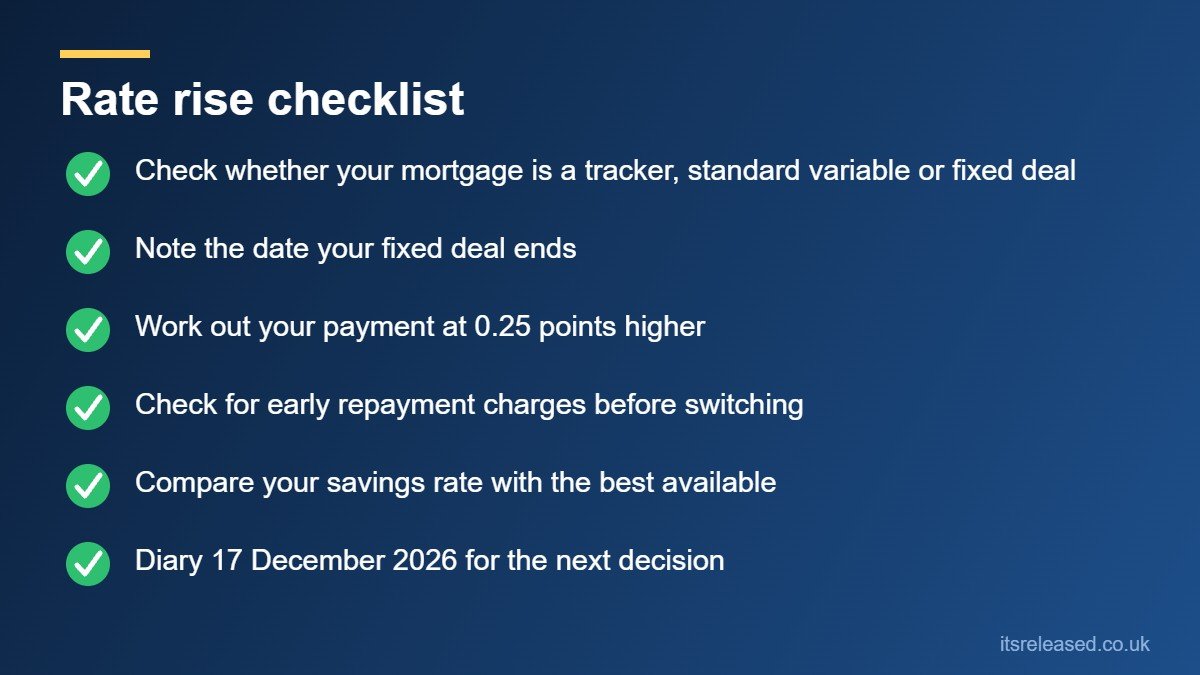
- Find your end date. It is on your mortgage statement or online account.
- Look at your options early. Many lenders let you secure a new rate several months before your current deal ends, so check what yours allows.
- Compare more than the headline rate. Arrangement fees, cashback and early repayment charges all change the real cost.
- Consider an adviser. A whole-of-market broker can compare deals you cannot see on your own lender’s site, though they may charge a fee.
What It Means for Savers
A higher Bank Rate can mean better savings rates, but nothing forces a bank to pass the rise on, and when it happens varies by provider. Variable-rate and instant-access accounts are the ones most likely to move, while fixed-rate savings are priced off market expectations, which had already factored in further rises. The practical step is simple: check what your current account pays and compare it with the best available, because inertia is expensive.
One safety point matters when you chase rates across providers. The FSCS deposit protection limit rose from £85,000 to £120,000 per person, per authorised firm on 1 December 2025, according to the FSCS and the Bank of England. Joint accounts are protected up to £120,000 per eligible person. Some brands share a single banking licence, so check before spreading large balances.
Loans, Credit Cards and Other Borrowing
Existing fixed-rate personal loans do not change when Bank Rate moves. Credit card APRs are set by the card provider and do not usually move automatically with Bank Rate, though the cost of new borrowing can drift upwards as lenders reprice. Overdrafts and some variable-rate products are set at the lender’s discretion, so check your terms. If you are budgeting for the festive season, our Christmas budget planner can help you avoid borrowing more than you need.
What Happens Next
The next Bank Rate decision is on Thursday 17 December 2026 at 12 noon. After that come 4 February 2027, which includes a new Monetary Policy Report, then 18 March and 29 April 2027. What the committee does depends mostly on inflation, energy prices and the conflict that is feeding them. Even after this rise, 4% sits below the long-run average: Mortgage One puts the average since 1975 at 6.11%. That does not make a 4% rate cheap for someone who took out a mortgage when rates were near zero, but it is useful context.
Frequently Asked Questions
Have interest rates gone up in the UK?
Yes. The Bank of England raised Bank Rate from 3.75% to 4% on 5 November 2026, its first increase since August 2023.
What is the Bank of England base rate now?
4.00%, following the 8 to 1 vote on 5 November 2026.
When is the next Bank of England interest rate decision?
Thursday 17 December 2026, announced at 12 noon.
Will my fixed-rate mortgage payment go up?
No, not until your fixed period ends. At that point you will be offered or will need to choose a new deal at the rates available then.
How much more will my tracker mortgage cost?
Roughly £14 a month for every £100,000 borrowed on a 25-year repayment mortgage, or about £28 on £200,000 and £42 on £300,000.
Will mortgage rates keep rising?
Nobody can say for certain. The Governor was reported as saying this rise is unlikely to be the last unless the Middle East conflict is resolved, and markets expect Bank Rate nearer 4.8% by late 2027, but fixed rates move with market pricing and can change from week to week.
Is 4% a high interest rate historically?
It is below the long-run average of 6.11% since 1975, according to Mortgage One, but it is far above the near-zero rates of the 2010s.
Are my savings protected if my bank fails?
Eligible deposits are protected by the FSCS up to £120,000 per person, per authorised firm.
The Bottom Line
The 5 November rise matters most to people on trackers and variable rates, who will see higher payments straight away, and to anyone whose fixed deal ends in the next year. Know which group you are in, work out your payment at the new rate, and look at your options before your deal ends rather than after. Savers should check that their provider has passed the rise on. The next decision, on 17 December, will show whether this was a one-off or the start of a run.
Sources consulted: Mortgage One, Mortgage Professional (Moneyfacts data), Sovereign Magazine, Nationwide, the Bank of England and the FSCS.