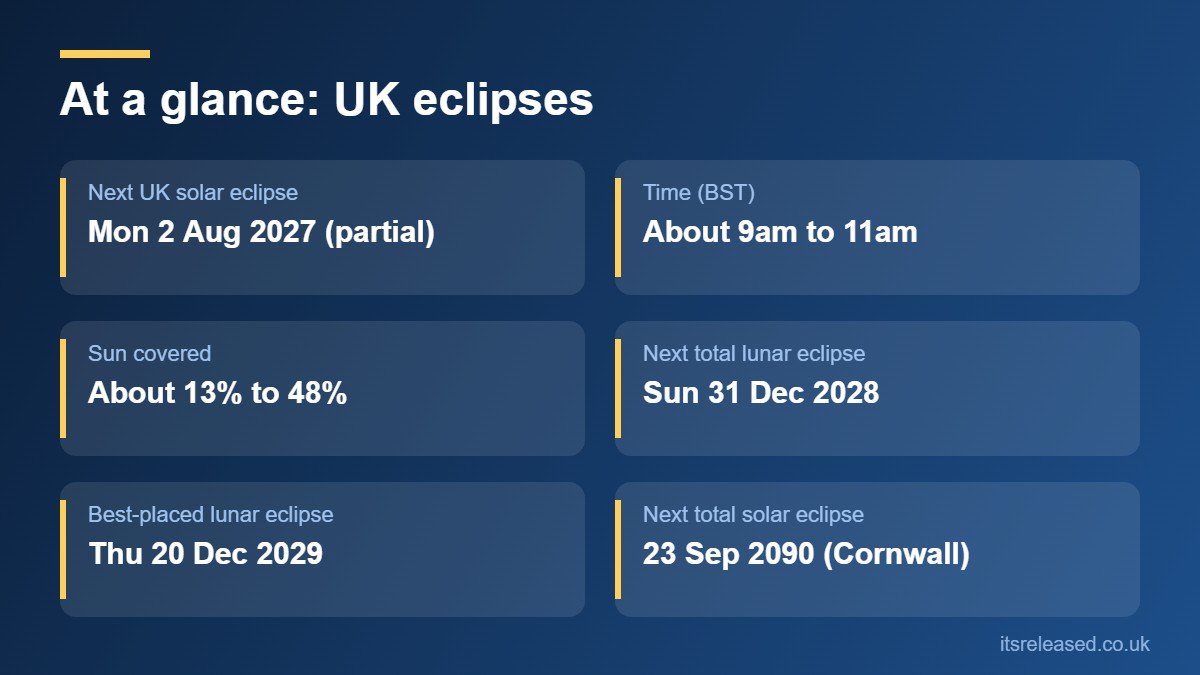
The next eclipse you can see from the UK is the partial solar eclipse on Monday 2 August 2027. It begins at around 9am, peaks at around 10am and ends shortly before 11am BST. According to BBC Sky at Night Magazine, the Moon will cover about 48% of the Sun from the Isles of Scilly, falling to about 13% from Shetland. The next total lunar eclipse you can see from the UK falls on New Year’s Eve 2028, the best-placed one follows on 20 December 2029, and the next total solar eclipse visible from British soil is not until 23 September 2090.
Searches for “next eclipse UK” have been surging on Google Trends, which is understandable. The deep partial solar eclipse of 12 August 2026 was the biggest the country had seen since 1999, and plenty of people are now asking whether they missed their one chance. This guide lists every UK-visible eclipse worth knowing about, what each one will really look like from Britain, and how to watch without harming your eyes.
Next Eclipses Visible From the UK at a Glance
Dates and types below come from timeanddate.com’s UK eclipse list, with local detail from Royal Museums Greenwich, BBC Sky at Night Magazine and Orbital Radar’s eclipse calculator. Penumbral lunar eclipses are included for completeness, but they are so faint that most people will not notice anything.

| Date | Type | What the UK sees | Best time to look |
|---|---|---|---|
| Sat 20 Feb 2027 | Penumbral lunar | Very faint shading on the Moon | Late evening |
| Mon 2 Aug 2027 | Partial solar | Roughly 13% to 48% of the Sun covered | About 9am to 11am BST |
| Tue 17 Aug 2027 | Penumbral lunar | Very faint shading on the Moon | Morning |
| Wed 12 Jan 2028 | Partial lunar | Part of the Moon dips into Earth’s shadow | Small hours, around 4am GMT |
| Wed 26 Jan 2028 | Partial solar | Around half the Sun, but the Sun is setting as it peaks | From about 3:35pm GMT |
| Sun 31 Dec 2028 | Total lunar | The Moon rises already in eclipse, low in the east-north-east | Moonrise about 3:50pm; totality about 4:16pm to 5:28pm GMT |
| Thu 20 Dec 2029 | Total lunar | Whole eclipse visible, Moon high in the sky | Evening, peak around 10:40pm GMT |
| Sat 1 Jun 2030 | Partial solar | Around half the Sun, at sunrise | Early morning |
| Sat 23 Sep 2090 | Total solar | Totality in Cornwall, close to sunset | Evening |
The Next Solar Eclipse: Monday 2 August 2027
This is the one to plan for. On 2 August 2027 a total solar eclipse crosses southern Spain, Gibraltar, North Africa and the Middle East, while the UK sits well to the north of the path of totality and sees a partial eclipse instead. Royal Museums Greenwich points out that even in Spain, totality is limited to the far southern tip.
What time is it?
Timings shift by a few minutes depending on where you stand. LBC’s guide gives 8:57am to 11:01am BST as the overall window, while calculators for London put the first contact at about 9:03am, the maximum between roughly 9:55am and 10:00am, and the end at around 10:56am to 11:00am. As a rule of thumb: be outside by 9am, expect the best of it at 10am, and it is over by 11am.
How much of the Sun will be covered?
BBC Sky at Night Magazine says the Isles of Scilly get the most, at about 48%, and Shetland the least, at about 13%. Everywhere in between falls in that range, and the further south-west you are, the bigger the bite. Different calculators give slightly different percentages for the same town, usually because some report the share of the Sun’s width that is covered and others the share of its area. For London, figures from about a third up to 42% are quoted, so treat any single number as approximate.
Where will the Sun be?
This one is easy to find. Orbital Radar’s calculations for London and Birmingham put the Sun about 40 degrees up in the south-east at the maximum, so you do not need a clear low horizon. Compare that with August 2026, when the eclipse happened around sunset with the Sun only about 10 to 13 degrees above the north-western horizon.
More in News
What will it look like?
A partial eclipse of 30% to 45% is a modest event. Through eclipse glasses the Sun will look like a fat crescent, but at this depth the daylight barely changes to the naked eye, so do not expect the strange dimming you get with a very deep partial eclipse like the one on 12 August 2026.
What Happened on 12 August 2026 (and Why 2027 Is Smaller)
The partial eclipse on 12 August 2026 was the most dramatic seen from the UK since the total eclipse of 11 August 1999, according to Royal Museums Greenwich. It ran from roughly 6pm to 8pm BST, lasted about 1 hour 50 minutes from the UK, and covered between about 90% and 96% of the Sun. The path of totality crossed Greenland, Iceland and northern Spain, missing the British Isles by a few hundred miles, and the Royal Observatory Greenwich livestreamed the event from its roof.
| Detail | 12 August 2026 | 2 August 2027 |
|---|---|---|
| Type from the UK | Deep partial | Partial |
| Time of day | Evening, about 6pm to 8pm BST | Morning, about 9am to 11am BST |
| Maximum coverage | About 89% to 96% (around 91% in London) | About 13% to 48% |
| Sun’s position at the peak | Low, roughly 10 to 13 degrees up in the north-west | High, about 40 degrees up in the south-east |
| Where it was or will be total | Greenland, Iceland, northern Spain | Southern Spain, North Africa, Middle East |
| Verdict | Best since 1999 | A modest morning partial |
The previous UK partial eclipse, on 29 March 2025, covered around 30% to 40% of the Sun at its maximum, which makes 2027 a similar scale rather than a repeat of 2026.
Lunar Eclipses: The Next Ones Worth Staying Up For
A partial lunar eclipse took place on 28 August 2026, so the next few are underwhelming. The penumbral eclipses on 20 February 2027 and 17 August 2027 dim the Moon only very slightly, and a partial eclipse follows in the small hours of 12 January 2028. The first properly dramatic one is a total lunar eclipse, the so-called blood Moon, on New Year’s Eve 2028.
31 December 2028: a New Year’s Eve blood Moon
Timeanddate’s timetable, given in UTC (the same as GMT in winter), has the partial phase beginning at 15:07, totality running from about 16:16 to 17:28, and the maximum at 16:52. Wikipedia’s eclipse summary puts totality at about 71 minutes. The catch is the Moon’s height. From London the Moon rises at about 15:50 GMT, already in eclipse, and Orbital Radar calculates it will be only about 7 degrees above the horizon at the maximum, in the east-north-east. You will want an unobstructed horizon, so think hilltops, coastlines and open fields rather than a city street.
20 December 2029: the best-placed total lunar eclipse
If you only mark one lunar eclipse in your diary, make it Thursday 20 December 2029. Orbital Radar’s figures for London show the Moon up for the entire eclipse, with the maximum at about 22:41 GMT and the Moon around 58 degrees above the horizon, high in the southern sky. For Glasgow the same source gives totality at roughly 22:14 to 23:09 GMT, so expect just under an hour in the Earth’s full shadow (Wikipedia puts it at 53 minutes 44 seconds).
There is also a total lunar eclipse in the early hours of 26 June 2029, but the Moon will be low in the south-west and the midsummer sky never gets fully dark from most of the UK, so it is a poor target compared with December.
Watching a lunar eclipse
Unlike a solar eclipse, a lunar eclipse is completely safe to look at with the naked eye. Binoculars or a small telescope bring out the colours as the Moon turns coppery red, because the only sunlight reaching it has been bent through the Earth’s atmosphere. Dress warmly, as both of the eclipses above fall in winter.
The Big Ones: 2081 and 2090
Anyone hoping for something on the scale of 2026 faces a long wait. Dr Greg Brown, an astronomer at the Royal Observatory Greenwich, has said the UK will not see a better eclipse than August 2026 until 2081. On 3 September 2081 up to 99% of the Sun will be covered, with Cornwall and the south coast best placed, according to Royal Museums Greenwich. The next total solar eclipse visible from the UK mainland is on Saturday 23 September 2090. Secret London describes its track as similar to 1999 but shifted slightly north and occurring near sunset, with roughly two minutes of totality in Cornwall.
| Date | Type | What to expect from the UK |
|---|---|---|
| 1 Jun 2030 | Partial solar | About 50% of the Sun, at sunrise |
| 14 Nov 2050 | Partial solar | Around 80% in most areas, less in the far south and south-west |
| 3 Sep 2081 | Near-total solar | Up to 99%, best from Cornwall and the south coast |
| 23 Sep 2090 | Total solar | Totality in Cornwall, near sunset |
Royal Museums Greenwich also lists other notable partial eclipses in 2053, 2066, 2075, 2082 and 2088, with coverage somewhere between about 40% and 70%.
How to Watch a Solar Eclipse Safely
Looking at the Sun, even when most of it is hidden, can burn the retina. The Yorkshire Evening Post’s explainer notes that the damage is painless, so you may not realise it is happening until it is too late, and a dimmer Sun can override your natural reflex to look away. Here is what is and is not safe.
| Method | Safe? | Notes |
|---|---|---|
| Eclipse glasses marked ISO 12312-2 | Yes | Check the marking. Do not use them if the lenses are scratched, creased or damaged. |
| Handheld solar viewer (ISO 12312-2) | Yes | Same checks as glasses. |
| Pinhole projector, colander or the gaps between tree leaves | Yes | Turn your back to the Sun and watch the projected image on paper or the ground. Never look through the hole at the Sun. |
| Telescope or binoculars with a proper solar filter | Yes, if the filter is made for the job | The filter must cover the front of the instrument. A local astronomical society can advise. |
| Ordinary sunglasses | No | They do not give adequate protection, however dark they look. |
| Telescope, binoculars or camera with no solar filter | No | Can cause instant, permanent damage to your eyes and to the equipment. |
| Live stream | Yes | The Royal Observatory Greenwich streamed the 2026 eclipse for free, and similar streams are likely in 2027. |
Counterfeit glasses are a genuine concern. Doctors warned ahead of the 2026 eclipse against knock-off pairs, according to LBC, and shops across London ran out of certified glasses with people queueing for hours. Buy from established retailers or museum shops, check for the ISO 12312-2 marking and be wary of unfamiliar online listings. Our guide to spotting phishing emails and scam texts covers the warning signs of fake shopping sites.
How to Plan for 2 August 2027
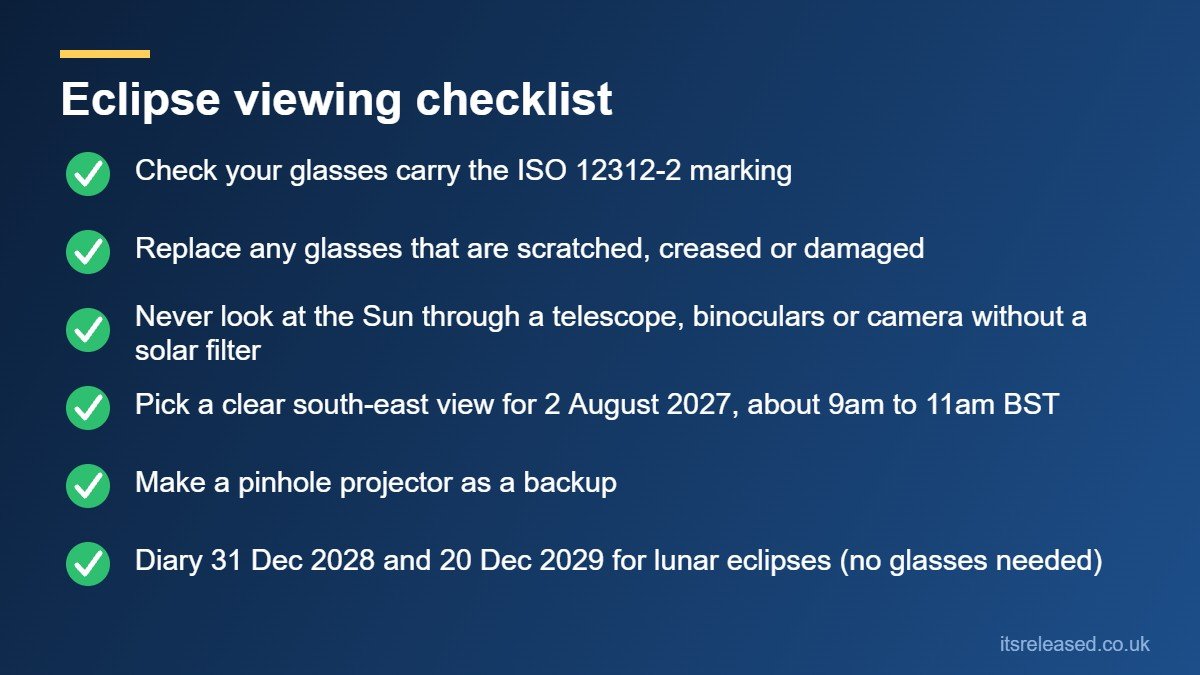
- Diary the date. Monday 2 August 2027, roughly 9am to 11am BST, falls on a working morning for most people, so decide now whether you will watch from home, work or school.
- Sort your glasses early. Royal Museums Greenwich reported its shop and online stock sold out before the 2026 eclipse. If you kept a pair, inspect it carefully and replace it if the lenses are scratched or creased.
- Choose a south-east view. The Sun will be about 40 degrees up, so a garden, balcony or park is fine.
- Plan for cloud. Watch the forecast in the days before and have a livestream as a backup.
- Buying optics? If a telescope, binoculars or camera is on your list in the sales, buy a proper solar filter at the same time and never point the instrument at the Sun without it. Our Black Friday 2026 smart shopping tips can help you avoid overpaying.
Frequently Asked Questions
When is the next solar eclipse in the UK?
Monday 2 August 2027. It is a partial eclipse lasting roughly from 9am to 11am BST, covering around 13% to 48% of the Sun depending on your location.
When is the next total solar eclipse in the UK?
Saturday 23 September 2090, with totality in Cornwall. The closest thing before then is 3 September 2081, when up to 99% of the Sun will be covered.
When is the next lunar eclipse in the UK?
The partial lunar eclipse of 28 August 2026 has passed. Faint penumbral eclipses follow on 20 February 2027 and 17 August 2027, then a partial eclipse on 12 January 2028, and a total lunar eclipse on 31 December 2028.
Was the August 2026 eclipse total in the UK?
No. The UK saw a deep partial eclipse covering about 90% to 96% of the Sun. Totality was limited to Greenland, Iceland and northern Spain.
Do I need eclipse glasses for a lunar eclipse?
No. A lunar eclipse is safe to watch with the naked eye, binoculars or a telescope.
Are sunglasses safe for watching a solar eclipse?
No. Ordinary sunglasses do not block enough light. Use glasses or viewers marked ISO 12312-2, or a pinhole projector.
Can I photograph a solar eclipse with my phone?
You can, but the Sun is intense enough to damage a camera sensor, so put a certified solar filter or a spare pair of eclipse glasses over the lens, and wear your own glasses while you aim it.
How much of the Sun will London see in 2027?
Calculators quote anything from about a third up to 42%, depending on whether they measure the width or the area of the Sun that is covered. The maximum is around 10am BST.
The Bottom Line
For most people in the UK the plan is simple. Mark Monday 2 August 2027 for a modest morning partial solar eclipse, put 31 December 2028 and 20 December 2029 in the diary for lunar eclipses that need no equipment, and accept that the next near-total solar eclipse is in 2081. Check timings again nearer each date, because calculators can differ by a few minutes.
Sources consulted: Royal Museums Greenwich, BBC Sky at Night Magazine, timeanddate.com, Orbital Radar, Wikipedia, LBC, the Yorkshire Evening Post and Secret London.