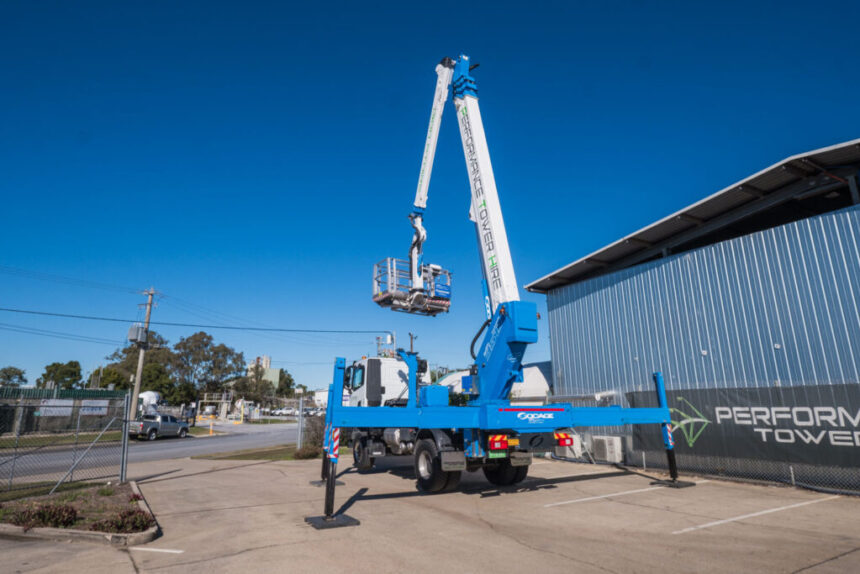
Working at height isn’t the time for guesswork. Truck-mounted cherry pickers make the job faster and safer — if they’re set up and operated properly. Below is a practical guide you can share with your team: quick checks, plain-English rules, and the small habits that prevent the big incidents.
TL;DR for busy crews
- Do a documented pre-use check every shift.
- Only trained operators (IPAF 1b) on the controls.
- Stabilise the ground and use outriggers/mats correctly.
- Clip on: harness + lanyard to the specified anchor.
- Keep 3m+ from power lines (more if voltage is unknown).
- Don’t overload the platform (include tools & attachments).
- Watch the weather — many stop at ~28 mph winds.
- Communicate: radios + a designated banksman.
- Stay inside the work envelope — never “stretch”.
- Keep LOLER inspections up to date (every 6 months).
1) Start with a pre-use inspection (no shortcuts)
Five minutes now saves an incident later. Check:
- Hydraulics for leaks
- Tyre pressures, wheel chocks, and outriggers
- Emergency stop & interlocks
- Guardrails, gates, platform floor, stabilisers
Pro tip: keep a laminated checklist in the cab and a photo of the signed sheet in your site log. Auditors love it — and so do insurers.
2) Trained operators only (and refreshers matter)
No licence, no joysticks. For truck-mounted booms, operators should hold IPAF 1b and be briefed on the specific model you’re using. New site? Do a quick familiarisation before first lift. Refresher training turns “I think” into “I know” under pressure.
3) Make the ground your friend
The platform is only as safe as what it stands on. Survey for:
- Soft spots, slopes, trenches, covers, or voids
- Underground services (cables, drains)
- Traffic routes and pedestrian walkways
Lay ground protection mats if needed and fully deploy outriggers. If you’re not sure, you’re not sure: stop and reassess.
4) Dress for the job (and clip on)
Mandatory basics:
- Harness + lanyard clipped to the correct anchor point
- Hi-vis, hard hat with chin strap, safety boots
- Gloves that suit the weather and the work
Avoid loose clothing and lanyards trailing near moving parts. It sounds obvious — until it isn’t.
5) Give overhead hazards real space
Electricity can arc; you don’t need contact to get hurt. Keep 3 metres clear of overhead lines as a baseline, and more if the voltage is unknown. Use a spotter where space is tight, and build the clearance into your method statement — not as an afterthought.
6) Respect the SWL (it’s not a suggestion)
Your Safe Working Load includes people + tools + attachments (lighting rigs, cameras, fixings). Overloading reduces stability, eats into reach, and can cause structural failure. Weigh the awkward stuff; don’t guess – especially when operating a truck mounted cherry picker.
7) Wind, rain, lightning — know your stop points
Most manufacturers recommend no work from ~28 mph (12.5 m/s) and above. Use an anemometer on site; phone apps aren’t good enough. Light rain is usually fine if the machine is rated for it, but thunderstorms = down tools. Build weather triggers into the RAMS so nobody argues later.
8) Speak clearly, move smoothly
Agree your comms plan before you elevate:
- Radios or hands-free headsets
- One banksman in charge of signalling
- Clear hand signals as backup
No shouting across the site, no mixed messages, no “I thought you meant…” moments.
9) Stay within the work envelope
Booms have limits for up, out, and over. Those load/height charts aren’t decoration — they’re your rulebook. If you need “just a bit further,” reposition the truck, don’t lean or climb. That’s how tip-ins and basket strikes happen.
10) Keep LOLER tight and your logs tighter
Under LOLER 1998, truck-mounted cherry pickers require a 6-monthly thorough examination by a competent person. Keep maintenance and inspection records on site and accessible. If an inspector asks, you should be able to show proof in seconds.
Real-world habits that separate safe sites from lucky ones
- Bank your checklists: photo every completed pre-use sheet.
- Weather board: write the current wind speed at start of shift.
- Walk the route: trace travel paths before you move the truck.
- Tool tally: count tools in/out of the basket; no loose kit.
- Knock-off rule: anyone can stop the job if they’re uneasy.
“The number one cause of MEWP incidents is improper use — not mechanical failure. Safety starts with the operator.”
— FESS Hire Operations Director
FAQs (snippet-friendly)
What qualification do I need to operate a truck-mounted cherry picker?
An IPAF 1b licence and familiarity with the specific model on site.
Can I use a cherry picker in the rain?
Usually in light rain if the machine is rated for it, but high winds or electrical storms mean pause. Follow the manufacturer’s limits; many stop at ~28 mph.
Do cherry pickers need LOLER inspections?
Yes — a thorough examination every 6 months by a competent person, with records kept up to date.
How close can I work to power lines?
Maintain at least 3 metres clearance; increase the distance if the voltage is unknown. Use a spotter and include this in your RAMS.