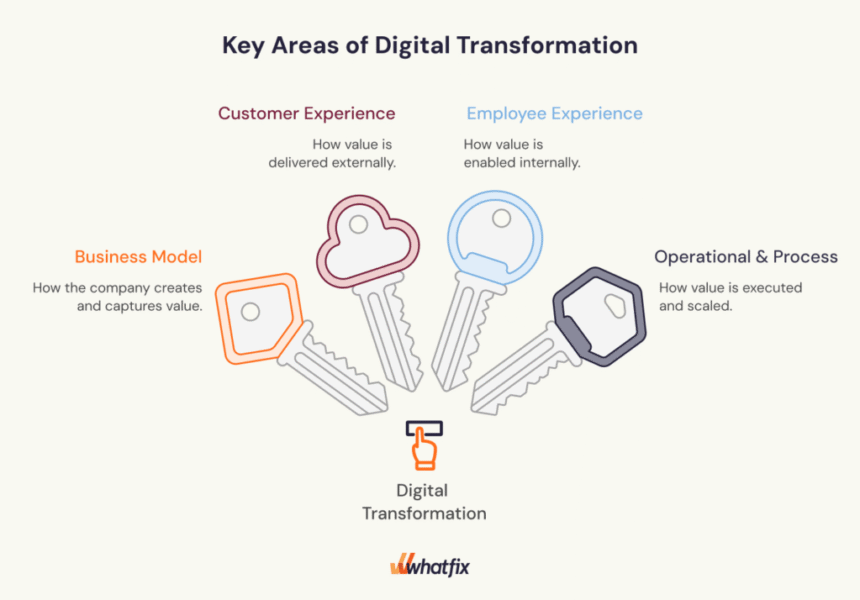
There has been a rapid digital transformation with the advent of technology in several areas of life. The word ‘digital transformation’ is not a buzzword anymore. Today, it has taken a strategic shift for enterprises to stay competitive and facilitate better operational efficiency. Industrial IoT emerges as a game-changer among all the technologies fueling this shift. The key point is that it connects not just machines but equips the businesses to move at a faster pace in this digital scenario.
IIoT has made a drastic change in the landscape of manufacturing where it acts as a connecting link between physical operations and digital intelligence. This enables organizations to make faster decisions, optimize systems, and make predictions with the help of data-driven analytics. To cope with this scenario, industries need to modernize their operations. IIoT has become the foundation upon which meaningful transformation is built.
The Changing Landscape of Industrial Operations How The Industrial Operations Have Evolved
Industrial operations in several sectors, like manufacturing, logistics, energy, automotive, and utilities, face mounting pressure in terms of reducing downtime and delivering improved operational efficiency. The traditional quality standards of industrial operations are not relevant in today’s manufacturing scenario due to various reasons. The production levels have grown at a massive scale; the costs incurred upon production have rapidly increased. So, how do we maintain a balance on key factors like productivity, costs and manufacturing goals. The answer is, we need to focus on using digital technologies that connect machines, processes, and redefine manufacturing workflows. This eventually helps in elevating quality and consistency.
We need to have a system in place that helps in gaining real-time visibility across industrial assets and processes. Adopting an IIoT platform has a benefit in giving a bird’s eye view into industrial operations.
It supports the development of an operating system that is both compliant and sustainable. This allows businesses to integrate disparate procedures and create a data-driven manufacturing workflow system.
Why IIoT Is Central to Digital Transformation?
IIoT has drastically changed business operations and brought forth a system that connects machines, sensors, and devices digitally for better operational efficiency and improvised workflows. Let us explore in detail how IIoT harnesses digital transformation.
- Real-Time Data as a Strategic Asset
The implementation of IIoT enables continuous data flow from sensors, machines, assets, and field operations. In the traditional system of workflow management, the company had to rely on periodic reports or manual logs. But with IIoT platforms, businesses get live data from a centralized dashboard, instant alerts and notifications on malfunctioning, anomalies or irregularities in manufacturing units. The company can gain predictive insights to facilitate better functioning and drive actionable intelligence to foster better decision-making. There is greater operational management in terms of cutting downtime and reducing time loss.
- Predictive Maintenance as the New Normal
Industrial operations have often depended upon scheduled maintenance and reactive repairs, and this seems to lead to costly disruptions. The IIoT platforms can now track machine health with the help of sensors that are embedded, continually tracking temperature, humidity, energy consumption, etc. This can help with early detection of errors, anomalies, equipment failures, etc. Hence, it saves time with repairing after a breakdown happens and instead takes steps to automate maintenance scheduling.
- Smarter Workflows Powered by Intelligent Automation
As IIoT platforms can easily integrate with existing ERPs, CRMs and other enterprise systems, data travels continuously and intelligently without any interruption. This helps in streamlining workflows without manual intervention. An example would be that of stock alerts that can be obtained in real-time from warehouses or production lines. In this way, automated purchase orders are initiated when they reach a threshold level. Similarly, there is better energy distribution with monitoring facilities based on optimal energy use, thereby cutting energy waste and reducing costs. This sort of end-to-end automation enhances decision-making, giving way to smarter, smoother industrial operations.
- Enabling Operational Agility and Scalability
As modern businesses expand; there arises a need to scale quickly to adapt to changing needs. It could be by way of opening new production lines, incorporating additional machinery, expanding into new markets, or responding to sudden shifts in customer demand. Such traditional methods turned out to be rigid systems, making things difficult. With IIoT solutions, there is greater flexibility to evolve without disruption.
For instance, a cloud-powered IIoT platform is capable of adding new devices, sensors, machines, and assets into the ecosystem without much hassle. There is no complex configuration or onboarding difficulties involved in it.
A remarkable feature about IIoT platforms is that several digital capabilities can be added, like adding analytics modules, integrating new applications, or enabling remote monitoring. These capabilities foster businesses.
Customizable dashboards and reports when enabled by teams across operations, maintenance, quality, and leadership tend to the specific needs of companies. This ensures that the right insights reach the right people at the appropriate time.
In this manner, companies can scale their operations securely. With strong security, encrypted data, and controlled access, businesses can safely expand their digital systems without risking security or breaking compliance rules.
- Intelligent Decision-Making Fostered by AI in IIoT Platforms
IIoT platforms allow access to raw data, while AI helps in transforming that data into valuable insights. This valuable data helps in drawing decisions for organizations. It plays an important role in predictive analytics, detection of patterns, and analysis of root causes. This sort of smart decision-making through combining AI elements forms the foundation of digital transformation.
- Where an Advanced IIoT Platform Fits In
An IIoT platform centralizes all connected data into a single repository providing information that is extracted from sensors, devices, assets, etc. This helps in monitoring, analyzing and drawing useful insights.
Key capabilities of IIoT solutions include:
- Device and asset management
- Real-time monitoring
- Data ingestion and analytics
- Alerts and notifications
- Workflow automation
- API integrations
- Role-based dashboards
In short, we can say that an IIoT platform becomes the prime engine that helps teams to act faster, innovate continuously, and operate with complete visibility.
IIoT As a Strategic Advantage for Future- Ready Enterprises
It has been observed that enterprises that adopt IIoT solutions stands a greater chance to gain a competitive edge in the market. It paves the way for faster, data-driven decisions. It’s quite undeniable that businesses that operate with IIoT render better operational efficiency, paving the way for better asset management. Reducing downtime is a pivotal feature of IIoT platforms as it can minimize unnecessary costs, delivering longer asset lifespans.
IIoT is not just another component facilitating digital transformation but infact a technology that caters to advanced solutions reducing costs and increasing efficiency. As global industries are transitioning towards Industry 4.0 and edge-powered operations, companies even seem to adopt software development services to meet technological and business needs and optimize performance with an AI-first approach.
Investing in an intelligent IIoT foundation now puts organizations in a position to construct the smart factories, smart fleets, and smart infrastructure of the future while also continuously innovating and confidently navigating change. Above all, investing in IIoT platforms enhances resource management in a sustainable way.