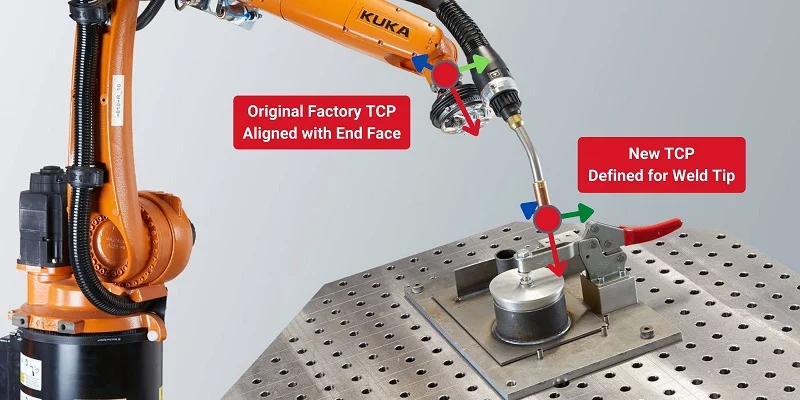
Have you ever wondered how precision tools achieve such incredible accuracy in manufacturing and machining? The secret lies in a concept known as Tool Center Point, or TCP. This term might sound technical, but it plays a crucial role in the world of industrial processes. Understanding what is tool center point can unlock new levels of efficiency and effectiveness for businesses that rely on automated systems.
Think about it: every time a robotic arm moves to cut, weld, or assemble components, it relies on its ability to pinpoint the exact location where work needs to be done. That’s where TCP comes into play—guiding movements with remarkable precision. Whether you’re an industry veteran or just curious about automation technologies, grasping this key concept will enhance your understanding of modern manufacturing practices. Let’s dive deeper into the fascinating world of Tool Center Point and discover why it’s essential for today’s industries!
Understanding Tool Center Point (TCP)
Tool Center Point (TCP) refers to a specific point in the tool or end effector of a robotic system. It represents the precise location where operations, such as cutting or welding, occur during manufacturing processes.
Establishing this reference point is crucial for accuracy. When machines operate, they must know exactly where to position their tools relative to the workpiece. TCP simplifies these calculations by providing a fixed coordinate that can be easily referenced throughout various movements.
In essence, TCP serves as a bridge between the machine’s control signals and real-world action. By effectively programming TCP into robotic systems, manufacturers ensure high-quality outcomes with minimal errors. This direct correlation enhances productivity and reduces waste—two key factors in competitive industries today.
Understanding Tool Center Point empowers engineers and operators alike to optimize automation processes while maintaining precision across tasks.
Importance of TCP in Industrial Processes
Tool Center Point (TCP) plays a crucial role in industrial processes. It acts as the reference point for tool movements, ensuring precision and accuracy during machining operations.
Without a well-defined TCP, even slight deviations can lead to significant errors. This impacts product quality and increases waste. Manufacturers rely on accurate TCP calculations to maintain consistency across production runs.
Moreover, identifying the correct TCP streamlines programming for CNC machines. Operators can fine-tune their equipment with better confidence, leading to enhanced efficiency in production cycles.
In industries where time is money, effective use of TCP reduces downtime and speeds up setup times. The result? Faster turnaround without compromising on quality or safety standards.
By prioritizing TCP in operational strategies, companies gain a competitive edge while optimizing resource utilization. This makes it an indispensable element of modern manufacturing practices.
How is TCP Determined?
Determining the Tool Center Point (TCP) involves precise measurements and calculations. It starts with identifying the geometry of the tool and its relationship to the machine.
Operators often refer to a specific point on the tool, usually at its tip or center, which serves as a reference for machining operations. This requires an understanding of both coordinate systems: the machine’s coordinate system and that of the tool.
Advanced machines use sensors and software that automatically calculate TCP during setup. These technologies enhance accuracy by eliminating human error.
In manual setups, operators may rely on dial indicators or laser alignment tools for verification. Each method has its own level of precision, so choosing wisely based on application is crucial.
Furthermore, environmental factors such as temperature can affect measurements; therefore adjustments are sometimes necessary to maintain accuracy in real-time operations.
Different Methods for Calculating TCP
Calculating Tool Center Point (TCP) can be approached in various ways, depending on the machinery and process involved. One common method is using a probe tool. This involves physically touching the workpiece with the probe to gather precise coordinates, ensuring accurate positioning.
Another popular technique is software-based calculation. Advanced CAD/CAM systems can automatically determine TCP through simulation models. This approach reduces human error and speeds up the setup process significantly.
Inverse kinematics is also employed in robotics for calculating TCP. By understanding joint configurations of robotic arms, it allows for more flexible programming options while maintaining precision.
Manual calculation remains relevant in certain scenarios where operators might rely on basic geometry or trigonometry to find center points accurately. Each method carries its own advantages and disadvantages based on application requirements and technological constraints.
Common Uses of Tool Center Point
Tool Center Point (TCP) plays a crucial role in various industries, particularly in manufacturing and robotics. It serves as the reference point for tool movements, ensuring precision during cutting or assembly processes.
In CNC machining, TCP is essential for accurate part fabrication. By defining where the tool engages with material, manufacturers can achieve high-quality finishes and tight tolerances.
Robotic arms also rely on TCP for effective operation. When performing tasks like welding or painting, knowing the exact center of tools allows robots to execute complex maneuvers flawlessly.
Moreover, in 3D printing technology, maintaining an accurate TCP ensures layers are deposited correctly. This attention to detail enhances structural integrity and surface quality of printed objects.
In automated inspection systems, understanding TCP helps calibrate sensors that measure dimensions or detect flaws. High accuracy in these applications minimizes errors and improves product reliability across various sectors.
Challenges and Solutions for Accurate TCP Calculation
Accurate Tool Center Point (TCP) calculation is vital for precision in machining and manufacturing. However, several challenges can hinder this process.
One significant issue is the variability of tool wear. As tools age, their geometry changes, which affects TCP accuracy. Regular monitoring and adaptive compensation are essential to mitigate these effects.
Environmental factors also play a role. Temperature fluctuations can lead to thermal expansion or contraction of materials, skewing measurements. Implementing temperature control systems in production environments helps maintain consistency.
Another challenge arises from complex tool geometries used in advanced applications. Traditional methods may not suffice here, necessitating sophisticated software solutions that utilize advanced algorithms for precise calculations.
Training operators on the importance of TCP and its implications can further enhance accuracy levels across the board. A well-informed workforce is instrumental in minimizing human errors during setup and operation phases.
Conclusion: The Future of Tool Center Point Technology
The landscape of Tool Center Point (TCP) technology is rapidly evolving. As industries push for higher precision and efficiency, advancements in TCP calculations are becoming essential. Emerging technologies such as artificial intelligence and machine learning are paving the way for more accurate and faster TCP determinations.
Automation continues to play a significant role in enhancing how TCP is managed. With smart machinery capable of self-adjusting based on real-time data, the potential for errors decreases significantly. This not only saves time but also reduces material waste.
As we look ahead, integrating advanced sensors and IoT capabilities into machining processes will likely lead to even greater accuracy in determining tool positions. The future holds promise for seamless integration across various platforms, enabling manufacturers to maximize productivity while maintaining high standards of quality.
Staying abreast of these innovations will be crucial for businesses aiming to maintain a competitive edge in an increasingly complex industrial environment. Embracing new methodologies around Tool Center Point technology can lead to remarkable improvements across multiple sectors.