Spanish, like many languages, has different verb tenses to express actions that occur at various times. One of the most important tenses to master is the future tense, which allows speakers to discuss events that are yet to happen. Whether you’re learning Spanish as a second language or brushing up on your skills, understanding how Spanish verbs future work is essential.
In this article, we will dive deep into the rules and structure of Spanish verbs in the future tense, the formation of regular and irregular verbs, and helpful tips for mastering this aspect of the language.
What is the Future Tense in Spanish?
The future tense in Spanish is used to express actions that will happen at some point in the future. It is equivalent to the English “will” or “shall” when talking about actions that are expected or predicted.
For example:
-
I will go to the store. → Yo iré a la tienda.
-
She will study for the exam. → Ella estudiará para el examen.
In Spanish, the future tense is formed differently than in English, and there are distinct rules depending on whether the verb is regular or irregular.
How to Conjugate Regular Verbs in the Future Tense
Conjugation Rules for Regular -AR, -ER, and -IR Verbs
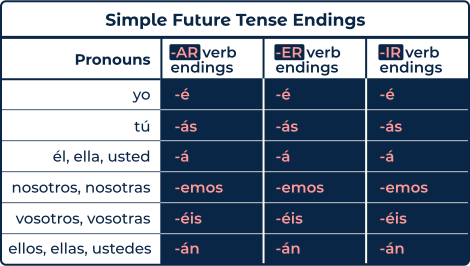
To conjugate regular verbs in the future tense in Spanish, you don’t need to remove the infinitive endings -ar, -er, or -ir. Instead, you simply add the correct future tense endings directly to the infinitive form of the verb.
Future Tense Endings
The future tense endings are the same for all verb types (-AR, -ER, -IR), and they are as follows:
-
yo (I) → -é
-
tú (you, informal) → -ás
-
él/ella/usted (he/she/you, formal) → -á
-
nosotros/nosotras (we) → -emos
-
vosotros/vosotras (you all, informal) → -éis
-
ellos/ellas/ustedes (they/you all, formal) → -án
For example:
-
Hablar (to speak) → yo hablaré (I will speak)
-
Comer (to eat) → yo comeré (I will eat)
-
Vivir (to live) → yo viviré (I will live)
Examples of Regular Verb Conjugations
Here’s how the conjugation of regular verbs in the future tense looks for all pronouns:
Hablar (to speak):
-
Yo hablaré (I will speak)
-
Tú hablarás (You will speak)
-
Él hablará (He/She will speak)
-
Nosotros hablaremos (We will speak)
-
Vosotros hablaréis (You all will speak)
-
Ellos hablarán (They will speak)
Comer (to eat):
-
Yo comeré (I will eat)
-
Tú comerás (You will eat)
-
Él comerá (He/She will eat)
-
Nosotros comeremos (We will eat)
-
Vosotros comeréis (You all will eat)
-
Ellos comerán (They will eat)
Vivir (to live):
-
Yo viviré (I will live)
-
Tú vivirás (You will live)
-
Él vivirá (He/She will live)
-
Nosotros viviremos (We will live)
-
Vosotros viviréis (You all will live)
-
Ellos vivirán (They will live)
Irregular Verbs in the Future Tense
What Makes a Verb Irregular in the Future Tense?
While regular spanish verbs future follow the standard conjugation pattern we just discussed, some verbs are irregular in the future tense. These verbs don’t follow the regular conjugation rules and undergo changes in their infinitive forms.
These changes typically involve replacing the infinitive stem with a new one before adding the future tense endings. Here’s a look at some of the most common irregular verbs in the future tense.
Common Irregular Future Tense Verbs
Here are a few of the most commonly used irregular verbs in Spanish and their future tense conjugations:
| Infinitive Verb | New Stem (Irregular) | Example: Yo (I) |
|---|---|---|
| Decir (to say) | dir- | diré (I will say) |
| Hacer (to do) | har- | haré (I will do) |
| Poder (to be able to) | podr- | podré (I will be able to) |
| Tener (to have) | tendr- | tendré (I will have) |
| Venir (to come) | vendr- | vendré (I will come) |
| Salir (to leave) | saldr- | saldré (I will leave) |
H3: Examples of Irregular Verb Conjugations
Let’s look at how the conjugation of these irregular verbs works:
Decir (to say):
-
Yo diré (I will say)
-
Tú dirás (You will say)
-
Él dirá (He/She will say)
-
Nosotros diremos (We will say)
-
Vosotros diréis (You all will say)
-
Ellos dirán (They will say)
Hacer (to do):
-
Yo haré (I will do)
-
Tú harás (You will do)
-
Él hará (He/She will do)
-
Nosotros haremos (We will do)
-
Vosotros haréis (You all will do)
-
Ellos harán (They will do)
Tener (to have):
-
Yo tendré (I will have)
-
Tú tendrás (You will have)
-
Él tendrá (He/She will have)
-
Nosotros tendremos (We will have)
-
Vosotros tendréis (You all will have)
-
Ellos tendrán (They will have)
When to Use the Future Tense in Spanish
Talking About Predictions
The future tense is often used to talk about predictions or things that are expected to happen.
For example:
-
Mañana lloverá. (Tomorrow, it will rain.)
-
Creo que ellos llegarán tarde. (I think they will arrive late.)
Expressing Intentions
You can also use the future tense to express personal intentions, similar to how we use “will” in English.
For example:
-
Voy a estudiar mañana. (I will study tomorrow.)
-
Ellos irán al cine esta noche. (They will go to the movies tonight.)
Speculation About the Present
Interestingly, the future tense in Spanish can also be used to speculate about the present, often translated as “must be” or “probably is” in English.
For example:
-
¿Quién será esa persona? (Who must that person be?)
-
¿Qué hora será? (What time must it be?)
Tips for Mastering the Future Tense
Practice Regularly
As with all aspects of language learning, practice is key to mastering the future tense. Consistently conjugating verbs in the future tense and using them in context will help solidify your understanding.
Learn Irregular Verbs Early
Irregular verbs can be tricky, but they are essential for fluency in Spanish. Make sure to learn the irregular verb stems early on to avoid confusion later.
Use Real-Life Situations
Try to incorporate the future tense in your daily conversations. For example, talk about your plans for the weekend, your goals, or what you expect to happen. This will make the language feel more practical and applicable.
Conclusion
The Spanish future tense is an essential tool for anyone learning the language, allowing speakers to discuss events yet to come. By mastering both regular and irregular verb conjugations, you can confidently express predictions, plans, and even speculate about the present.
Whether you are just starting or you are looking to refine your Spanish skills, understanding how to use Spanish verbs in the future tense will significantly enhance your ability to communicate effectively. Keep practicing, and soon you’ll find that speaking about the future in Spanish comes naturally.