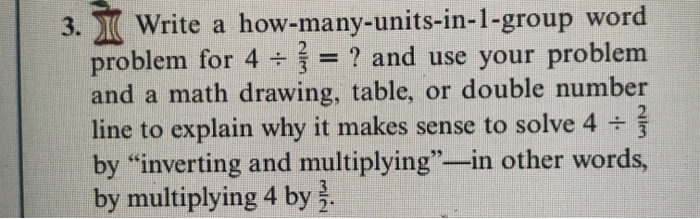
Word problems are a common part of math education, designed to help students apply mathematical concepts to real-world scenarios. Among these, questions involving “how many units in one group word problem” are particularly useful for understanding division, multiplication, and the concept of ratios. In this article, we will explore how to approach these types of word problems, breaking down the strategies and providing examples to help clarify the process.
What Does “How Many Units in One Group” Mean?
Understanding the Concept
The phrase “how many units in one group” typically refers to a situation where you need to determine the size of one group when you are given a total quantity and the number of groups. This concept can be applied to various mathematical operations, such as division, multiplication, and even ratios.
For example, if you have 12 apples and 4 baskets, the problem could be asking, “How many apples will be in each basket?” This question is essentially asking you to find the number of units in one group (in this case, apples in each basket).
Breaking It Down
To solve problems like this, we usually follow these steps:
-
Identify the total quantity (e.g., total apples, total number of items).
-
Identify the number of groups (e.g., number of baskets, containers, people).
-
Divide the total by the number of groups to determine how many units are in each group.
The mathematical operation that often comes into play in these types of word problems is division.
Types of Word Problems Involving “How Many Units in One Group”
Simple Division Problems
One of the most common types of problems in this category is simple division, where the total number is divided evenly among groups. Let’s go through an example.
Example 1 – Simple Division
Problem: There are 24 cookies, and you want to divide them equally into 6 bags. How many cookies will be in each bag?
Solution:
To solve this, divide the total number of cookies (24) by the number of bags (6).
246=4\frac{24}{6} = 4
Thus, there will be 4 cookies in each bag.
Real-World Scenarios
Real-world scenarios often present slightly more complex word problems, where the concept of “units in one group” is tied to quantities that are not evenly divisible. These problems may require rounding or dealing with remainders.
Example 2 – Uneven Division
Problem: You have 10 pencils and want to distribute them equally among 3 students. How many pencils will each student get?
Solution:
To solve this, divide the total number of pencils (10) by the number of students (3).
103=3 with a remainder of 1\frac{10}{3} = 3 \text{ with a remainder of } 1
So, each student will get 3 pencils, and there will be 1 pencil left over.
Advanced Word Problems Involving “How Many Units in One Group”
Problems with Mixed Operations
In some cases, a word problem may involve more than one operation to arrive at the solution. These problems may require both division and multiplication or other steps.
Example 3 – Mixed Operations
Problem: A teacher has 120 markers and needs to give each student 8 markers. How many students can she supply with markers, and how many markers will be left?
Solution:
First, divide the total number of markers (120) by the number of markers per student (8).
1208=15\frac{120}{8} = 15
So, the teacher can supply 15 students with 8 markers each. Since 120 markers are evenly divisible by 8, there will be no markers left.
Problems Involving Ratios
Another advanced scenario involves ratios, where you must determine how many units are in one group based on a ratio.
Example 4 – Ratio Word Problem
Problem: A recipe calls for a ratio of 3 cups of flour to 2 cups of sugar. If you use 12 cups of flour, how many cups of sugar do you need?
Solution:
The ratio of flour to sugar is 3:2. This means that for every 3 cups of flour, 2 cups of sugar are needed. To find out how many cups of sugar are required for 12 cups of flour, first find how many times the ratio fits into 12 cups.
123=4\frac{12}{3} = 4
Now, multiply 4 (the number of times the ratio fits into 12) by 2 (the number of cups of sugar in the ratio):
4×2=84 \times 2 = 8
Thus, you need 8 cups of sugar for 12 cups of flour.
Strategies for Solving “How Many Units in One Group” Word Problems
Key Strategies to Keep in Mind
When solving word problems related to “how many units in one group,” it’s important to follow a systematic approach:
Read the Problem Carefully
Understanding the context of the problem is essential. Make sure to identify the total quantity, the number of groups, and what is being asked.
Choose the Right Operation
Once you have identified the elements of the problem, decide which operation to use. In most cases, you will be using division, but there are situations where multiplication or addition may also be required.
Check for Remainders or Fractions
If you are dividing and the result is not a whole number, make sure to address the remainder or fraction. Some problems may ask for an approximate value, while others may require you to round to the nearest whole number.
Draw a Diagram if Necessary
For some problems, especially when dealing with ratios or complex distributions, drawing a diagram can help visualize the situation and make it easier to solve.
Common Mistakes to Avoid
Avoiding Pitfalls in Word Problems
While word problems are straightforward, there are a few common mistakes to watch out for:
1. Misinterpreting the Question
Sometimes, it’s easy to get confused about what the problem is asking. Make sure to re-read the question to ensure you understand what is being asked. Are you looking for the number of units in one group or the total quantity?
2. Forgetting to Account for Remainders
In problems where division doesn’t result in a whole number, it’s easy to overlook the remainder. Remember that even if the numbers don’t divide evenly, there’s often still a useful part of the answer.
3. Using the Wrong Operation
It’s important to ensure that you’re using the correct operation for the problem. For example, if the problem is asking for how many items each person will get, use division. If it’s asking how many items in total, use multiplication.
Conclusion: Mastering “How Many Units in One Group” Word Problems
In summary, solving word problems like “how many units in one group” requires a clear understanding of the problem’s context, careful attention to detail, and the ability to choose the correct mathematical operations. By following a systematic approach, practicing with various examples, and avoiding common pitfalls, you can confidently tackle word problems and apply mathematical concepts to real-life scenarios.
Whether dealing with simple division, ratios, or more complex situations involving multiple operations, the key is to break the problem down step by step. With these strategies in mind, you’ll be well on your way to mastering “how many units in one group” word problems and applying them effectively in your math studies.