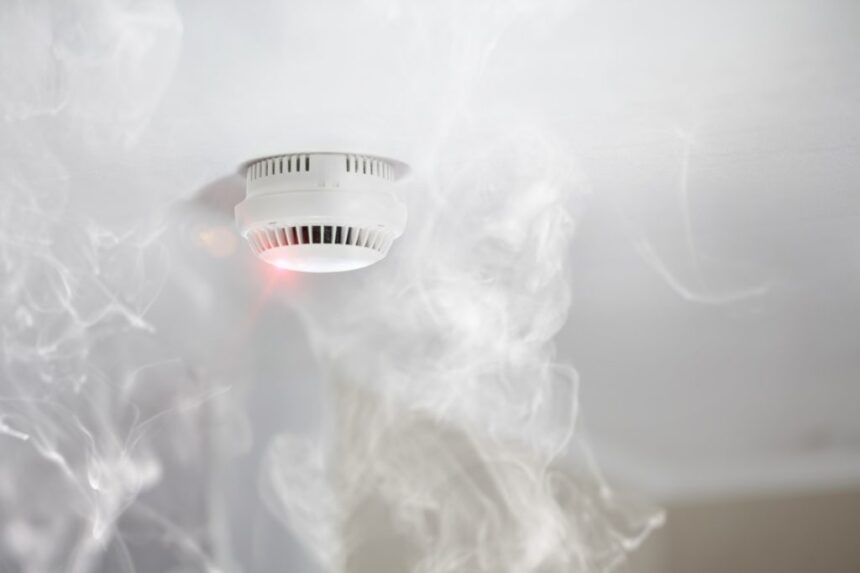
Behind every smoke alarm Singapore regulation lies a story of lives that might have been saved, and in the humid corridors of public housing estates, these stories take on profound urgency. A small plastic device mounted on ageing concrete ceilings has become both a symbol of governmental care and a stark reminder of how safety can divide along economic lines.
The Sound of Inequality
Walk through Toa Payoh’s void decks or Queenstown’s narrow walkways, and you’ll find Mrs. Lim, 67, whose arthritis makes it difficult to change batteries in devices mounted on her kitchen ceiling. She lives in a one-room rental flat where the walls are thin enough to hear her neighbour’s television.
Mrs. Lim represents Singapore’s Home Fire Alarm Device initiative, a programme revealing both promise and limitations of top-down fire safety policy. The Singapore Civil Defence Force launched the HFAD Assistance Scheme in 2017, promising “free installation of HFADs for all 60,000 HDB Public Rental flats.” Yet by completion, the take-up rate reached only 75%, leaving 15,000 units without basic protection.
The Architecture of Protection
Singapore’s approach to residential fire safety operates on a fundamental assumption: each home functions as its fire compartment. The SCDF explains that “each residential unit is a fire compartment by itself, total evacuation of the building occupants is not necessary.”
For new residential premises and those undergoing fire safety modifications, Singapore smoke detector installation became mandatory in June 2018.
The Technology of Early Warning
The science behind smoke detection technology reveals why these devices matter profoundly. According to SCDF guidance, “A smoke detector is more effective in providing early warning of fire compared to a heat detector.” In residential fires, smoke often proves more immediately lethal than flames.
Modern smoke detection systems Singapore has adopted include several key features:
-
Ten-year battery life, eliminating the maintenance burden that often leads to disabled devices
-
Photoelectric sensing technology provides a faster response to smouldering fires common in residential settings
-
Audio alarms exceeding 85 decibels, ensuring alerts penetrate through sleep and ambient noise
-
Self-testing capabilities indicating device functionality through regular status checks
-
Interconnectable options allowing multiple units to trigger simultaneously throughout larger homes
The Demographics of Safety
The HFAD Assistance Scheme targeted “housing estates with a higher number of rental households with elderly residents,” acknowledging what fire safety experts have long known: age, mobility, and economic status significantly influence fire survival rates. Elderly residents face multiple challenges during fire emergencies:
-
Reduced mobility limiting escape speed and route options
-
Hearing impairments potentially miss alarm signals
-
Social isolation is delaying emergency response and assistance
-
Medication effects that may slow reaction times during crises
The 25% of households that declined free installation reveal the complex relationship between safety technology and human behaviour. Reasons for declining included:
-
False alarm concerns from cooking smoke in small kitchens
-
Technology anxiety about unfamiliar devices in their homes
-
Government programme suspects viewing interventions with wariness
-
Installation disruption worries about strangers entering their homes
Beyond Compliance: The Reality of Protection
Singapore’s fire safety regulations extend beyond simple device installation. The Singapore Civil Defence Force mandates that smoke detection devices Singapore residents install must “comply with the requirements in SS 645,” referencing comprehensive technical standards governing sensor sensitivity and alarm duration.
For buildings with mixed residential and commercial use, requirements become more complex. The SCDF specifies that “an automatic fire alarm system is required in buildings of more than 4 storeys having a commercial cum residential mix,” creating layered protection systems coordinating individual unit detectors with building-wide emergency response.
The Economics of Early Warning
The cost differential between mandatory and voluntary installation reveals another dimension of fire safety inequality. While new developments must include the required smoke alarm systems Singapore authorities mandate, existing residents face purchasing devices themselves or remaining unprotected.
Fire statistics consistently show residential fires disproportionately affect older buildings and lower-income households, precisely the populations least likely to upgrade voluntarily.
Technological Evolution and Human Adaptation
Modern residential smoke alarm Singapore technology has evolved significantly, using advanced algorithms to distinguish between cooking smoke and fire-related particles, reducing nuisance alarms.
Smart home integration promises further improvements. Newer smoke alarm Singapore models send alerts to mobile phones, notify emergency contacts, and coordinate with building systems.
The Unfinished Business
Despite regulatory requirements and assistance programmes, gaps remain in Singapore’s residential fire protection landscape. Key challenges include:
-
Coverage gaps with 25% of public rental flats lacking HFADs
-
Ageing population living alone in older buildings
-
Increasing residential density, narrowing margins for error
-
Voluntary installation in pre-2018 buildings, creating protection inconsistencies
These gaps embody systemic challenges in translating safety policy into universal protection.
Moving Forward: Lessons in Universal Protection
Singapore’s experience with residential fire safety regulation offers insights into both possibilities and limitations of technology-based safety interventions:
-
Programme reached success with 75% coverage, demonstrating effective targeting
-
Persistent gaps reveal challenges in achieving universal protection
-
Behavioural complexity showing technology adoption depends on human factors
-
Economic disparities highlight how safety divides along income lines
The path forward requires understanding that fire safety technology succeeds only when it adapts to human realities, the elderly resident who struggles with installation, the family concerned about false alarms, and the household viewing government programmes with suspicion.
In the end, every mounted device represents both individual choice and collective commitment to protection. As Singapore continues refining its approach to residential fire safety, the challenge remains ensuring that early warning reaches every home, regardless of economic circumstances or personal vulnerabilities. The future lies not just in advancing technology, but in bridging the gap between regulatory intention and human reality, ensuring that every smoke alarm Singapore installs truly serves those whose lives depend on its faithful vigilance.