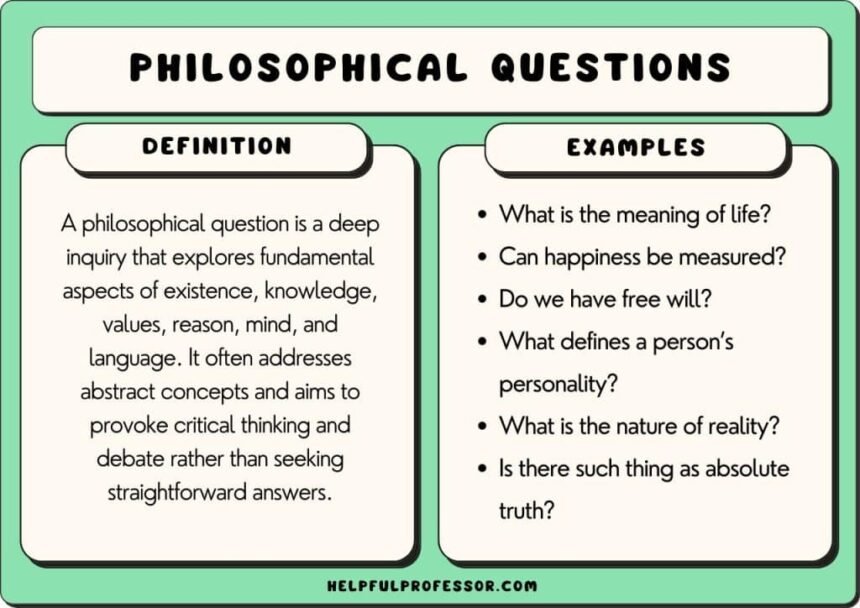
Philosophical questions have been an integral part of human thought for centuries, sparking contemplation, debate, and exploration of our very existence. These questions delve into the nature of reality, ethics, consciousness, and the universe itself. From the musings of ancient Greek philosophers to the modern-day intellectuals, philosophical questions challenge us to think beyond the surface level and explore deeper meanings and truths.
In this article, we will explore some of the most thought-provoking philosophical questions that have intrigued humanity for ages. By understanding these questions, we not only gain insight into philosophy itself but also cultivate a deeper understanding of life and existence.
What Are Philosophical Questions?
Philosophical questions are inquiries into the fundamental aspects of human experience, existence, and knowledge. They are often abstract, speculative, and open-ended, allowing for various interpretations and perspectives. These questions touch on topics such as ethics, metaphysics, epistemology, logic, and the mind-body problem, among others.
Unlike empirical or scientific questions that can be tested through experiments or observations, philosophical questions often seek to address issues that are not easily measurable or definable. They are more about exploring the “why” and “how” of existence and human nature rather than seeking concrete answers.
Types of Philosophical Questions
Philosophical questions can be categorized into several branches, each focusing on different aspects of life and the universe. Below are some of the key branches and the types of questions they address:
1. Metaphysics: The Nature of Reality
Metaphysics deals with questions about the fundamental nature of reality and existence. It explores concepts like time, space, causality, and the universe’s structure.
Key Metaphysical Questions:
-
What is the nature of existence?
-
Does the universe have a purpose, or is it just a random series of events?
-
Are we living in a simulation?
-
What is time, and does it exist independently of our perception?
2. Epistemology: The Study of Knowledge
Epistemology focuses on questions related to knowledge, belief, and justification. It examines how we come to know things, what it means to know something, and the limits of human knowledge.
Key Epistemological Questions:
-
What does it mean to know something?
-
Can we trust our senses to provide true knowledge?
-
How do we distinguish between belief and knowledge?
-
Is it possible to truly know anything for certain?
3. Ethics: The Moral Questions of Life
Ethics is concerned with questions of right and wrong, virtue and vice, justice, and the nature of good. It is the study of how humans should act and what constitutes a moral life.
Key Ethical Questions:
-
What is the meaning of a good life?
-
Is it ever right to lie?
-
What is the source of moral values?
-
Are humans inherently good or evil?
-
What is the best form of government?
4. Logic: The Principles of Reasoning
Logic deals with the principles of correct reasoning. It is the foundation for rational thought, used to evaluate arguments and make decisions based on facts and evidence.
Key Logical Questions:
-
What constitutes a valid argument?
-
Can logic help us determine the truth about the world?
-
What is the relationship between truth and reasoning?
5. Philosophy of Mind: Consciousness and Identity
The philosophy of mind deals with the nature of consciousness, the self, and personal identity. It addresses questions about the mind-body problem and what it means to be human.
Key Questions in the Philosophy of Mind:
-
What is consciousness?
-
Is the mind separate from the body, or are they interconnected?
-
Do we have free will, or is our behavior determined by physical processes?
-
What does it mean to have personal identity?
The Importance of Philosophical Questions
Philosophical questions play a vital role in our understanding of life. They encourage deep thinking and critical analysis, forcing us to question assumptions and beliefs that we might otherwise take for granted. Engaging with these questions allows individuals to:
1. Expand Perspectives
Philosophical questions challenge us to view the world from multiple viewpoints. By engaging with different philosophical ideas, we gain insight into other cultures, worldviews, and ideologies. This broader perspective promotes tolerance, empathy, and a more open-minded approach to life.
2. Seek Meaning in Life
One of the primary functions of philosophical questions is to help us find meaning and purpose in our lives. By contemplating questions about existence, morality, and the universe, we can better understand our own place in the world and what we should strive for.
3. Enhance Critical Thinking Skills
Philosophical questions require us to think logically and systematically. They encourage us to analyze arguments, weigh evidence, and form well-reasoned conclusions. These critical thinking skills are invaluable not only in philosophy but also in everyday life.
4. Challenge Assumptions
Many of the most profound philosophical questions arise from challenging commonly held beliefs and assumptions. By questioning the status quo, we can uncover new ideas, challenge outdated systems, and push the boundaries of human understanding.
Philosophical Questions for Reflection
Here are some classic and contemporary philosophical questions to ponder:
1. What is the meaning of life?
This age-old question has intrigued philosophers, religious thinkers, and individuals for centuries. Is life inherently meaningless, or do we create our own purpose? Can meaning be found through relationships, work, or personal growth?
2. Is there a God?
The existence of God is one of the most debated philosophical questions in history. Arguments for and against the existence of a divine being span centuries of thought, from ancient religious texts to modern atheism and agnosticism.
3. Do we have free will?
Are our actions determined by forces outside of our control, such as biology, environment, or fate? Or do we have the power to choose our actions independently? This question touches on ethics, psychology, and metaphysics.
4. What happens after we die?
Questions about the afterlife have occupied human thought for millennia. Do we continue to exist in some form after death, or is death the end of consciousness? Different religions and philosophies offer varying answers to this question.
5. Can machines think?
With the rise of artificial intelligence, the question of whether machines can possess consciousness or self-awareness has become a hot topic in both philosophy and technology. Could a machine ever experience emotions or creativity like humans?
Conclusion: Embracing the Mystery
Philosophical questions are not meant to provide definitive answers but to push the boundaries of our understanding. They encourage us to explore the unknown, question our assumptions, and seek deeper truths about existence, morality, and knowledge.
By contemplating philosophical questions, we embark on a journey of self-discovery and intellectual growth. While we may never fully answer all of these questions, the process of grappling with them enriches our lives and helps us understand the complexities of the human experience.
Whether you are pondering the meaning of life, exploring the nature of reality, or seeking answers to ethical dilemmas, philosophical questions offer a valuable framework for thinking about the world around us. Embrace these questions, challenge your beliefs, and continue exploring the profound mysteries that shape our lives.