Financial crime today moves with speed, sophistication, and global reach. Traditional monitoring tools that rely only on rules or isolated transaction reviews fall short when criminals use layered structures, shell companies, money mules, and cross border flows to hide illicit activity. These networks are built to blend into normal behavior, making them hard to detect with conventional tools.
The main challenge for compliance teams is visibility. Isolated transactions show only a narrow view. The true risks sit within the hidden relationships connecting accounts, entities, and behaviors.
This is why network analysis is becoming essential in modern AML programs. By visualizing financial activity as graphs rather than spreadsheets, investigators can uncover patterns and connections that would otherwise remain buried.
What Is Network Analysis in AML?
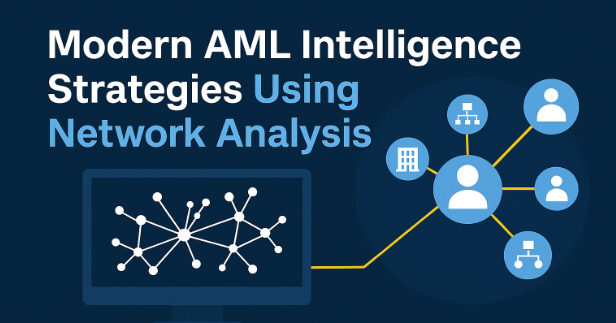
Network analysis maps entities and the relationships between them. It transforms complex movement of funds into a connected structure made of:
- Nodes such as people, accounts, companies, and devices
- Edges such as transactions, shared IP addresses, phone numbers, addresses, or beneficial ownership links
Instead of reading static lists of transactions, investigators explore a dynamic map of interactions.
Why Network Analysis Matters for AML
Money laundering almost never happens through simple, standalone transactions. Criminals rely on:
- Multiple layering steps
- Mule accounts
- Dormant or shell companies
- High volume low value transfers
- Rapid routing across borders
- Secrecy jurisdictions
Network analysis exposes these clusters and their hidden structure in ways rules cannot.
How Network Analysis Strengthens AML Investigations
1. Detecting Hidden Beneficiaries and Shell Structures
Even well crafted shell companies show suspicious traits once mapped. Network graphs reveal:
- Shared directors
- Reused addresses
- Circular fund movement
- Unusual clusters
2. Identifying Layered Transactions
Layering often appears normal when viewed transaction by transaction. Network visualization highlights:
- Circular flows
- Rapid multi-account transfers
- Unexplained central hubs
3. Revealing Collusion and Mule Networks
Seemingly unrelated accounts may share:
- Devices
- Emails
- IP addresses
- Contact details
These connections allow fast detection of organized mule activity.
4. Exposing Cross Border Risk Routes
Graph analysis shows movement through:
- High risk jurisdictions
- Sanctioned regions
- Known criminal hotspots
5. Strengthening SAR Investigations
Charts and relationship maps make it easier to:
- Identify the core suspicious entities
- Trace funds through multiple steps
- Write stronger narratives backed by visual evidence
Flagright’s resource on network analysis in AML investigations demonstrates how this relationship centered approach uncovers hidden crime structures that rule based tools often miss:
https://www.flagright.com/post/network-analysis-in-aml-investigations
Why Traditional Rule Based Monitoring Falls Short
Rules trigger on:
- Thresholds
- Rapid transfers
- High risk geographies
But these systems often:
- Miss structured low value laundering
- Create heavy false positive volumes
- Fail to capture relationships
- React to activity instead of predicting patterns
Criminals intentionally spread activity across many accounts and time periods to hide from these rules.
Network analysis connects the dots.
Key Techniques Used in AML Network Analysis
- Graph modeling: Finds influential nodes using centrality, clustering, or betweenness.
- Community detection: Groups related entities, useful for mule or cartel networks.
- Temporal analysis: Tracks how behaviors change over time.
- Geospatial mapping: Identifies high risk regional activity.
- Machine learning: Learns typologies and predicts new patterns.
Real World Scenarios Where Network Analysis Excels
| AML Problem | How Network Analysis Helps |
| Shell company layering | Reveals shared ownership and circular transactions |
| Money mule networks | Identifies device links between accounts |
| Terrorist financing | Maps indirect funding structures |
| Trade based laundering | Shows mismatched trade patterns |
| Crypto fraud | Connects on chain wallets to off chain identity |
Agencies such as FinCEN, FATF, and Europol highlight these models as essential for fighting organized crime.
How Network Analysis Improves AML Team Performance
- Cuts investigation time
- Reduces false positives
- Supports stronger SAR narratives
- Increases regulatory trust
- Improves case prioritization
Institutions using graph based intelligence often reduce false positives by more than 50 percent and accelerate alert triage.
Common Challenges Institutions Face
- Fragmented data across systems
- Missing or inconsistent identifiers
- Legacy tools without graph support
- Limited investigative bandwidth
- Difficulty explaining risk to executives or regulators
Modern platforms address these gaps by centralizing data and integrating relationship intelligence directly into case workflows.
Best Practices for Implementing Network Analysis
1. Centralize Data Pipelines
Bring KYC, transactions, device fingerprints, sanctions, adverse media, and ownership data into one investigation layer.
2. Use Visual Graphs Inside Case Management
Analysts should not need separate graph tools.
3. Apply Machine Learning Risk Scoring
Helps prioritize the highest impact nodes and clusters.
4. Combine Network Intelligence with Behavioral Monitoring
Layered detection is more accurate.
5. Train Investigators to Read Graphs
Graph literacy greatly improves investigative quality.
The Future of Network Based AML Tools
Network analysis will merge with:
- Real time anomaly detection
- Cross institution data collaboration
- Identity resolution across channels
- Immersive graph analytics
- Automated SAR generation with tagged evidence
Institutions that build these capabilities early gain faster, smarter, and more defensible AML programs.
Final Insight
Financial crime is not linear, so AML investigations cannot stay linear either. Network analysis turns compliance teams into proactive intelligence units capable of identifying criminal ecosystems before the damage spreads.
Institutions that want to modernize AML operations should prioritize relationship driven intelligence and integrate it within a unified technology stack. A modern AML compliance solution capable of real time monitoring and graph powered investigation gives teams the visibility needed to outpace evolving criminal behavior.